Introduction to the Arctic Circle
The Arctic Circle is one of the most remarkable geographical boundaries on Earth. Located at approximately 66.5° north latitude, it forms an imaginary line around the Northern Hemisphere and passes through parts of several countries, including Norway, Sweden, Finland, Russia, Canada, Greenland, Iceland, and the United States through Alaska.
The Arctic Circle is much more than a line on a map. It marks a region shaped by extreme seasons, frozen seas, vast tundra, powerful winds, and long periods of darkness and daylight. Its unusual conditions have created a distinctive environment where plants, animals, and people have developed remarkable ways to live with the Arctic climate.
The region is also important far beyond the polar region itself. Arctic sea ice, ocean currents, atmospheric circulation, wildlife populations, and changing temperatures all influence environmental systems around the planet. For travelers, meanwhile, the Arctic Circle offers extraordinary experiences, from observing wildlife to witnessing the Northern Lights.
Geography and Climate of the Arctic Circle
A Landscape of Ice, Snow, and Tundra
The landscape around the Arctic Circle varies considerably. Some areas are covered by glaciers and permanent ice, while others contain rocky mountains, coastal plains, wetlands, forests, and open tundra.
Trees become scarce as temperatures fall and growing seasons become shorter. Across much of the Arctic tundra, low-growing plants such as mosses, lichens, grasses, and small shrubs survive close to the ground. During the short summer, these plants can grow rapidly under almost continuous daylight.
The Arctic Ocean is another defining feature of the region. Floating sea ice expands and contracts with the seasons, creating an important habitat for marine animals and influencing the wider Arctic ecosystem.
Extreme Seasons
The Arctic climate is famous for its severe seasonal conditions. Winters can bring extremely low temperatures, strong winds, and extensive snow and ice. Summers are generally short, but some areas can experience surprisingly mild conditions for a brief period.
One of the most unusual characteristics is the polar day and polar night. During summer, locations north of the Arctic Circle can experience periods when the Sun does not set. In winter, the opposite occurs, with the Sun remaining below the horizon for an extended period.
These dramatic changes in light affect almost every part of Arctic life, including animal behavior, plant growth, migration, and human activities.
Arctic Wildlife and Ecology
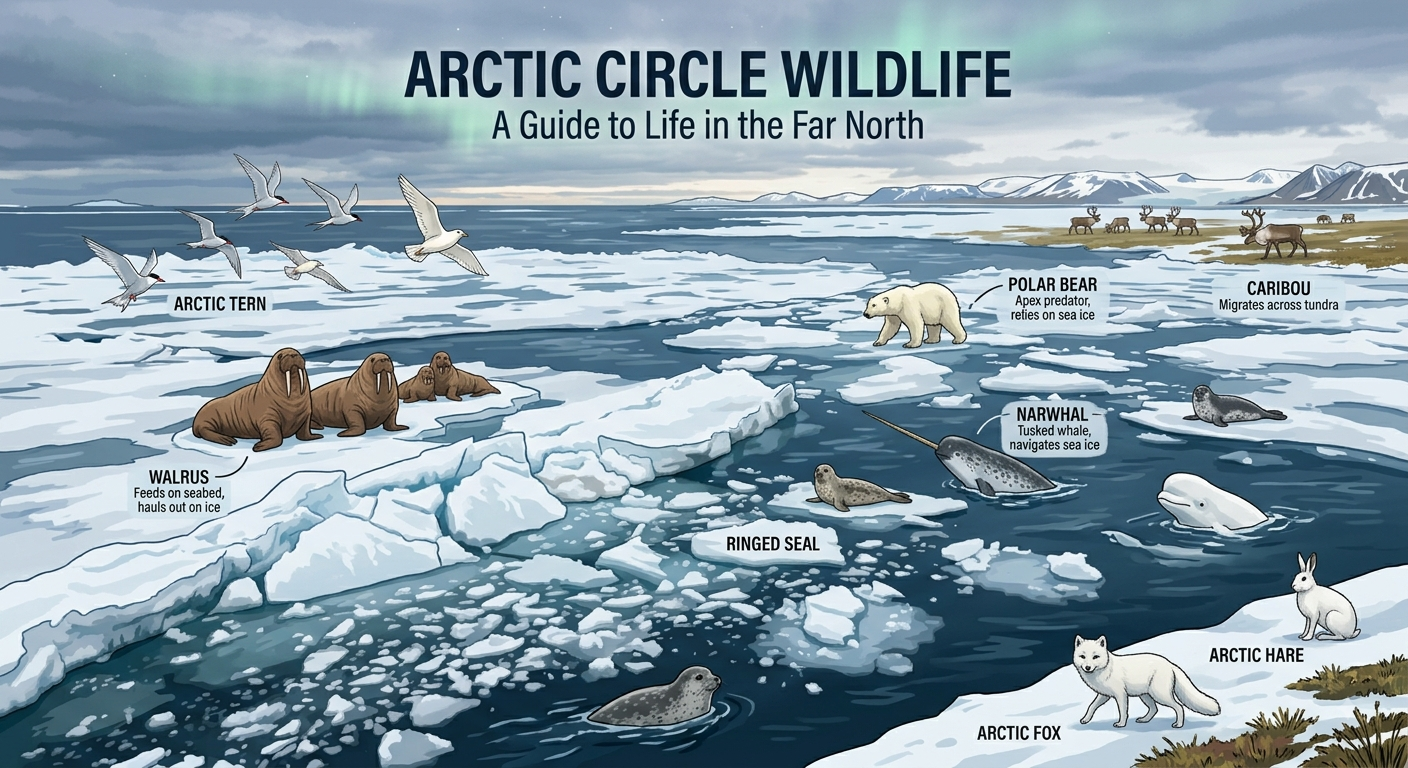
The Arctic wildlife community is specially adapted to cold temperatures, seasonal food supplies, and changing landscapes. Some animals remain in the region throughout the year, while others migrate thousands of kilometers to take advantage of seasonal opportunities.
Polar Bears
The polar bear is perhaps the most recognizable symbol of Arctic wildlife. These powerful marine mammals spend much of their lives associated with sea ice, where they hunt seals and travel between feeding areas.
Their thick fur and substantial layer of body fat help them retain heat. Their large paws also help them move across snow and ice and swim through cold water.
Because polar bears depend heavily on sea ice, changes in ice conditions can affect their ability to hunt, travel, and reproduce. Their situation has therefore become closely connected with discussions about climate change in the Arctic.
Arctic Foxes
The Arctic fox is a smaller but equally fascinating resident of the polar region. It has thick fur, compact ears, and a short muzzle that help reduce heat loss.
Its coat changes with the seasons in many populations. White winter fur provides camouflage against snow, while darker summer coloring can blend into the tundra landscape.
Arctic foxes are opportunistic feeders. Their diet can include small mammals, birds, eggs, fish, carrion, and other available food. This flexibility helps them survive in an environment where food supplies can change dramatically throughout the year.
Reindeer and Caribou
Reindeer, known as caribou in North America, are among the most important large herbivores of the Arctic and sub-Arctic. They travel in herds and may undertake extensive seasonal migrations.
Their specialized hooves help them move through snow and wet ground, while their ability to feed on lichens and other tundra vegetation allows them to survive where many other large animals cannot.
Reindeer are also deeply connected with human life in northern regions, particularly among several Indigenous communities that have developed cultural traditions and livelihoods around these animals.
Seals, Whales, and Marine Life
The Arctic Ocean supports an impressive variety of marine life. Seals are essential members of the food web, serving both as predators of smaller marine organisms and as important prey for animals such as polar bears.
Several whale species also visit or inhabit Arctic waters. Beluga whales, narwhals, bowhead whales, and other species are adapted to cold marine environments. Some migrate seasonally, following food supplies and favorable ice conditions.
Migratory Birds
The Arctic may look quiet during winter, but it becomes remarkably active during summer. Millions of migratory birds arrive from regions across the world to breed and feed during the short productive season.
Birds benefit from abundant insects, fish, and newly growing vegetation. Species such as Arctic terns undertake extraordinary migrations between polar regions, demonstrating how closely distant ecosystems can be connected.
How Arctic Animals Survive
Survival in the Arctic requires specialized adaptations. Many animals have thick layers of insulating fat or dense fur. Others reduce heat loss through compact body shapes and specialized circulation systems.
Behavior is equally important. Some species migrate to warmer areas, while others remain active beneath snow or enter periods of reduced activity. Seasonal changes in diet, reproduction, and movement help animals make the most of limited resources.
The Arctic ecosystem is therefore a complex network in which even small environmental changes can influence many species.
People and Life in the Arctic
The Arctic is not an empty wilderness. Millions of people live across the wider Arctic region, including numerous Indigenous communities with deep historical connections to the land and sea.
Indigenous Knowledge and Traditions
Indigenous peoples have developed detailed knowledge of local weather, animals, plants, ice conditions, and seasonal movements. Traditional hunting, fishing, herding, crafts, transportation, and food practices have evolved through generations of experience.
In many communities, the natural environment is not simply viewed as a source of resources. It is closely connected with culture, identity, history, and community life.
Modern Arctic communities combine traditional knowledge with contemporary education, technology, transportation, healthcare, and employment. However, remote locations can create challenges, including high living costs, limited infrastructure, and difficulties accessing services.
Climate Change in the Arctic
The Arctic is experiencing rapid environmental change. Rising temperatures are contributing to reductions in sea ice, changes in snow cover, melting glaciers, thawing permafrost, and shifts in ecosystems.
Effects on Wildlife
Less predictable ice conditions can make it harder for animals to travel, hunt, or reach breeding areas. Species that depend directly on sea ice can be particularly vulnerable.
Changes can also affect the timing and availability of food. As temperatures rise, some plants and animals may expand farther north, potentially changing relationships between established Arctic species.
Why the Arctic Matters Globally
What happens in the Arctic does not remain confined to the Arctic. Melting land ice contributes to global sea-level rise, while changes in snow and ice influence how much sunlight Earth reflects back into space.
The Arctic also plays a role in atmospheric and oceanic systems. For this reason, scientists closely monitor changes in the region to understand broader patterns of global climate change.
Northern Lights and Other Natural Wonders
The Arctic Circle is famous for extraordinary natural phenomena.
Aurora Borealis
The Northern Lights, or Aurora Borealis, occur when charged particles from the Sun interact with gases in Earth’s upper atmosphere. The resulting lights can appear as glowing curtains, arcs, or shifting bands across the night sky.
Although auroras can occur at different latitudes, Arctic destinations offer some of the world’s best opportunities for viewing them because of their location and long winter nights.
Midnight Sun
The Midnight Sun is another remarkable Arctic phenomenon. During part of the summer, the Sun remains visible around midnight rather than disappearing below the horizon.
This continuous daylight creates a strange and beautiful atmosphere. Mountains, lakes, forests, and tundra can remain illuminated late into the night, giving visitors an experience unlike ordinary summer travel.
Visiting the Arctic Circle
Arctic travel has become increasingly popular for people interested in nature, photography, adventure, and wildlife.
Popular destinations include northern Norway, Swedish and Finnish Lapland, Iceland, Greenland, northern Canada, Alaska, and parts of northern Russia. Each destination offers a different combination of landscapes, wildlife, cultural experiences, and seasonal activities.
Experiences for Travelers
Visitors may enjoy:
- Wildlife watching and nature photography
- Dog sledding and traditional-style Arctic transportation
- Snowshoeing and cross-country skiing
- Snowmobile excursions where permitted
- Northern Lights tours
- Hiking during the brighter summer months
- Cultural experiences with local and Indigenous communities
Travelers should prepare carefully for changing weather and understand that Arctic conditions can be demanding. Appropriate clothing, responsible wildlife viewing, local guides, travel insurance, and respect for local communities are especially important.
Conservation and the Future
Protecting the Arctic ecosystem requires cooperation among scientists, governments, local communities, conservation organizations, and travelers.
Wildlife conservation can include protecting important breeding and feeding areas, monitoring animal populations, reducing pollution, and managing human activity in sensitive habitats. Sustainable tourism can also help by limiting environmental damage and supporting local economies.
Scientific research remains essential. Researchers study sea ice, ocean temperatures, wildlife movements, permafrost, atmospheric conditions, and ecosystem changes to understand how the Arctic is evolving.
The future of the Arctic Circle will depend partly on global efforts to reduce greenhouse-gas emissions, but local conservation and adaptation will also remain important. Indigenous knowledge can contribute valuable observations and perspectives alongside modern scientific research.
Conclusion
The Arctic Circle is a remarkable meeting point of geography, wildlife, culture, climate, and natural beauty. Its frozen seas and tundra support animals specially adapted to extreme conditions, while Indigenous communities maintain long-standing relationships with the northern environment.
From polar bears and Arctic foxes to migrating birds and whales, Arctic wildlife depends on a delicate network of habitats and seasonal cycles. At the same time, the region’s changing sea ice and temperatures provide important warnings about the wider effects of climate change.
For travelers, the Arctic offers unforgettable experiences such as the Northern Lights, Midnight Sun, wildlife encounters, and vast landscapes. For scientists and conservationists, it remains a vital place for understanding Earth’s environmental future. Protecting this extraordinary polar region is therefore important not only for the Arctic itself, but for the planet as a whole.
✍️ Written by Vimal Bhagat
🌎 Sharing fresh news, trending stories & interesting updates from around the world.
💙 Read more: https://arcticcircle.us
