I am watching the Arctic closely this August 16, 2026, and the latest sea ice melting story is getting harder to ignore. The summer melt is still moving, while scientists are waiting for the yearly low point that usually comes in September. The exact final number is not known yet, but the warning signs are already loud.
What caught my attention is that Arctic sea ice began this summer from an unusually weak position. In March 2026, the Arctic reached its seasonal maximum at about 14.29 million square kilometres, tying 2025 for the lowest maximum in the satellite record. That was a strange start to a melt season that was already carrying a lot of concern.
Now the ice is shrinking again, as it normally does during the warmer months. But this is not simply an ordinary summer story. The Arctic has been losing ice for decades, and the September minimum has become dramatically smaller than it was when satellite monitoring started in 1979. Scientists say the September area has roughly halved over that period.
I know a melting ice sheet sounds far away for many people. It is easy to think this is just a polar problem, somewhere beyond the maps we see every day. But the Arctic is part of the Earth system, and when its bright ice disappears, darker ocean water is exposed. That water absorbs more sunlight, which can add more heat to the region.
This is one reason sea ice melting matters so much. Sea ice is not just a giant frozen blanket floating on the ocean. It helps reflect sunlight back toward space, influences the exchange of heat between the ocean and atmosphere, and creates living space for animals that depend on the frozen environment.
The timing is also important right now. Arctic sea ice usually reaches its smallest size in September. So even though August can look dramatic, scientists still have to wait before they know where the 2026 minimum will land. The UK Met Office says the September result remains highly uncertain because August melt rates can change greatly from year to year.
That uncertainty makes the news a little tricky. One hot week does not automatically mean a record will fall. One cloudy week does not mean the long-term problem has disappeared either. Weather can push the ice around from one year to another, while the larger climate trend keeps working in the background.
I find that part especially interesting. The Arctic can surprise scientists in one season, but the long-term direction is much clearer. The melt season itself has become longer. A 2026 study found that the average Arctic Ocean melt season increased by about nine days per decade from 1979 to 2023, adding up to nearly 40 extra days over the full period.
That means the ice is not only facing warmer conditions. It can also face a longer period in which melting can happen. Earlier melting and later freezing changes the calendar of the Arctic, almost like moving the hands on a giant frozen clock.
And there is another twist that scientists are now looking at. Recent research suggests melting sea ice can influence the tiny particles that help clouds form above the Arctic. When ice retreats and open water appears, gases released from the ocean and melting-ice environment can take part in chemical reactions in sunlight. Those reactions can create new particles in the air.
I did not expect clouds to become part of the sea ice story, but climate systems rarely stay in neat little boxes. Clouds can affect how much sunlight reaches the surface and how much heat leaves the Earth system. That makes this newly studied process important, although scientists are still working out exactly how large its climate effect may become.
The Arctic also started 2026 with another troubling number. January’s average sea ice extent was about 13.2 million square kilometres, around 5.5 percent below the 1991–2020 average. It was the third-lowest January extent in the 48-year satellite record.
Then came the March maximum, which tied the previous year’s record low for the smallest seasonal maximum. Put those pieces together and the picture looks uncomfortable. The Arctic entered the summer melt season with less ice than scientists would expect from the older climate record.
But I would not call every melting headline a record-breaking disaster. That would be too easy, and it would miss what the data actually says. The 2026 September minimum has not happened yet. Nobody can honestly announce the final number before the season ends.
The better story is this: the Arctic is entering another summer melt season from a very low baseline, and the final result will be closely watched. The National Snow and Ice Data Center updates sea ice information daily, normally with a one-day delay, using satellite observations and scientific analysis.
Satellite records are especially valuable because nobody can stand across the entire Arctic Ocean with a ruler. The ice stretches across millions of square kilometres, moves with winds and currents, cracks, refreezes and changes shape. Satellites give researchers a consistent way to watch these changes over many decades.
And the older record gives today’s numbers their meaning. Arctic sea ice naturally grows during the dark and cold months, then retreats as sunlight returns. That seasonal cycle is normal. What is not normal is how far the long-term baseline has shifted.
There is also a difference between sea ice and land ice that often gets mixed up in online conversations. Sea ice is frozen seawater floating on the ocean. When it melts, it does not directly raise sea level in the same way that melting land-based glaciers or ice sheets do. Still, losing sea ice has major climate and ecological consequences.
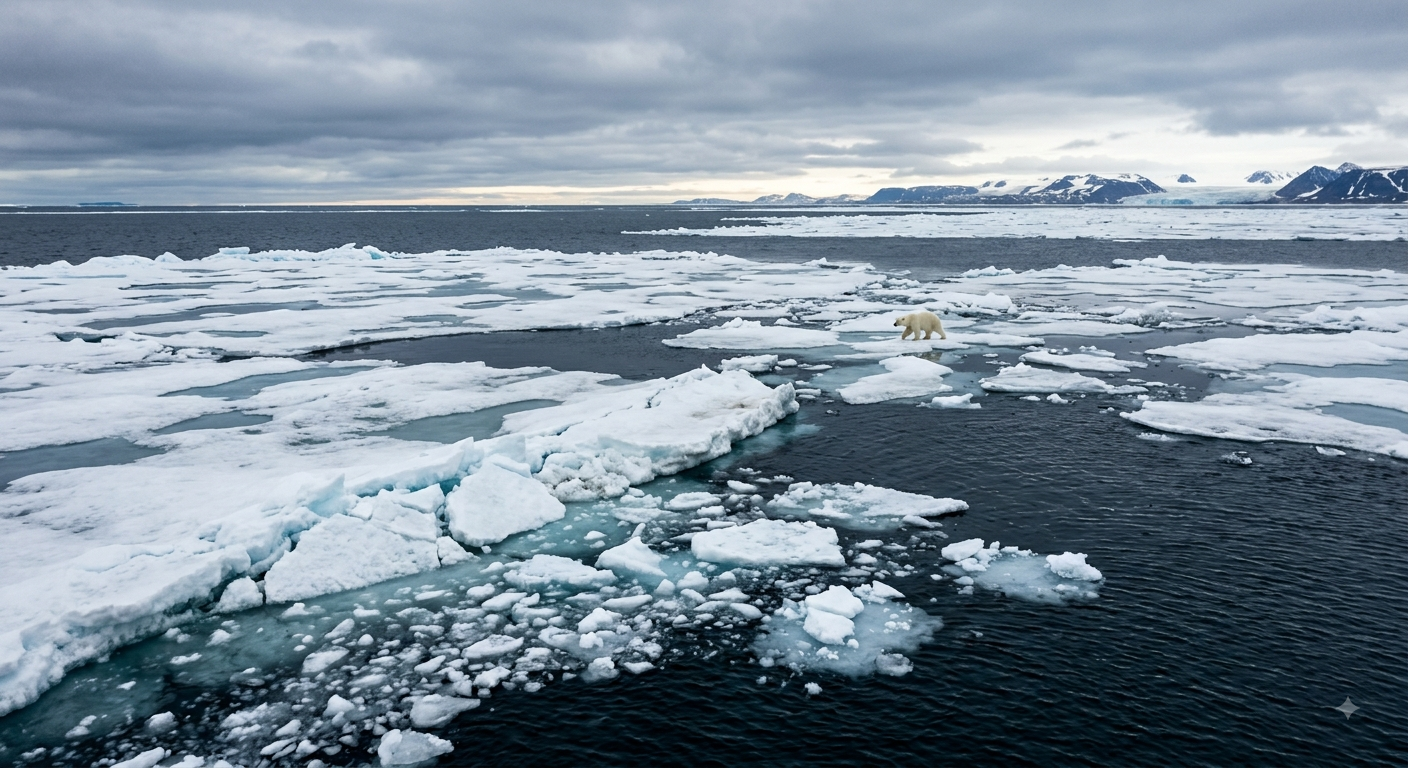
Polar bears are one obvious example. Their lives are closely connected with sea ice, especially for hunting. Seals also use ice for important parts of their lives. Walruses can be affected when changing ice conditions force them toward crowded coastal areas. The whole food web can feel the pressure, from tiny organisms to large predators.
For Arctic communities, this is not just a distant scientific graph. Sea ice conditions can influence travel, hunting, coastal safety and local ecosystems. A change that looks like a small line on a satellite chart can become a very real change on the ground.
I also noticed something else in the recent news: researchers are changing the way they measure the Arctic because the environment itself is changing. NASA scientists are using aircraft, satellites and ground observations together to improve measurements of sea ice.
That work matters because ice is complicated. Thickness can change even when the visible area does not change much. Snow can cover the surface. Melt ponds can confuse satellite readings. Wind can push ice together or spread it apart. So scientists do not rely on one picture and call the whole story finished.
This is why I think the most important number to watch next is the September minimum. The annual minimum is one of the clearest markers of the Arctic’s changing condition. A single year’s result will not explain everything, but a long sequence of low minimums tells a much bigger story.
There is some uncertainty around 2026, and that should be said clearly. The Met Office expects the September extent to remain within the broad post-2007 range, but it says the final outcome is still very dependent on Arctic weather during August and the weeks ahead.
So, yes, the ice is melting right now. But the bigger headline is not simply that ice disappears every summer. It is that the Arctic’s frozen season has changed, the long-term amount of summer ice has declined sharply, and recent winter and summer conditions continue to keep scientists watching closely.
For me, the strangest part is how quiet the change can look. There is no giant alarm bell ringing over the Arctic Ocean. Ice simply breaks, thins, retreats and leaves darker water behind. Day after day, the map changes a little.
Then the little changes add up.
Scientists will keep watching satellites as the 2026 melt season moves toward September. The final minimum could be higher or lower than some forecasts. Weather will have its say. Winds will move the ice. Warm ocean water can matter in some regions, while clouds and storms can change the pace somewhere else.
But whatever number arrives at the end of the season, it will become another piece in a much larger record.
And that record is the real news.
The Arctic is no longer behaving like the Arctic many people remember from old photographs and school maps. Its sea ice is still growing and shrinking with the seasons, but the amount, thickness, timing and persistence of that ice have changed. The latest research suggests the melt season itself has grown by nearly 40 days since 1979.
I will be watching the September number because that is when this year’s story gets its final summer chapter. Until then, every square kilometre matters. Every satellite pass adds another clue. Every week of melt can shift the result.
The Arctic may look silent from far away.
It is not silent at all.
Its ice is telling a very loud story.
✍️ Written by Vimal Bhagat
🌎 Sharing fresh news, trending stories & interesting updates from around the world.
💙 Read more: https://arcticcircle.us