August 16, 2026 — Why is the Arctic unique is a question that keeps drawing attention as people learn more about the far north. I often think the Arctic looks like a giant white world from far away. But when I look closer, it feels much more alive, strange, and important than I first imagined.
The Arctic is not just a place covered with snow. It is a huge region around the North Pole. It has sea ice, cold oceans, frozen ground, mountains, islands, rivers, and wide open lands. Some places stay frozen for much of the year. Other places change quickly when summer arrives.
What makes the Arctic special is the way many things work together there. The cold affects the land. The land affects animals. The ice affects the ocean. The ocean affects the weather. Even the sunlight behaves in a very unusual way.
I find the Arctic’s daylight one of its most amazing features. During parts of summer, the Sun can remain above the horizon for days or even months in some areas. This is called the midnight sun. It can feel like daytime never ends.
Then winter brings the opposite. Some Arctic areas can experience long periods when the Sun does not rise above the horizon. This is known as polar night. Imagine waking up, looking outside, and seeing darkness for many hours every day. It sounds like a story, but it is normal life in the high north.
It sits at about 66.5 degrees north latitude. Places north of this line can experience at least one day each year when the Sun does not set and another when it does not rise.
I think that simple fact already makes the Arctic different from most places on Earth. But the surprises do not stop there.
The ice is another huge part of the Arctic story. Sea ice forms when ocean water freezes. It is not the same as a giant sheet of ice sitting permanently on land. Arctic sea ice grows during the colder months and usually becomes smaller during the warmer months.
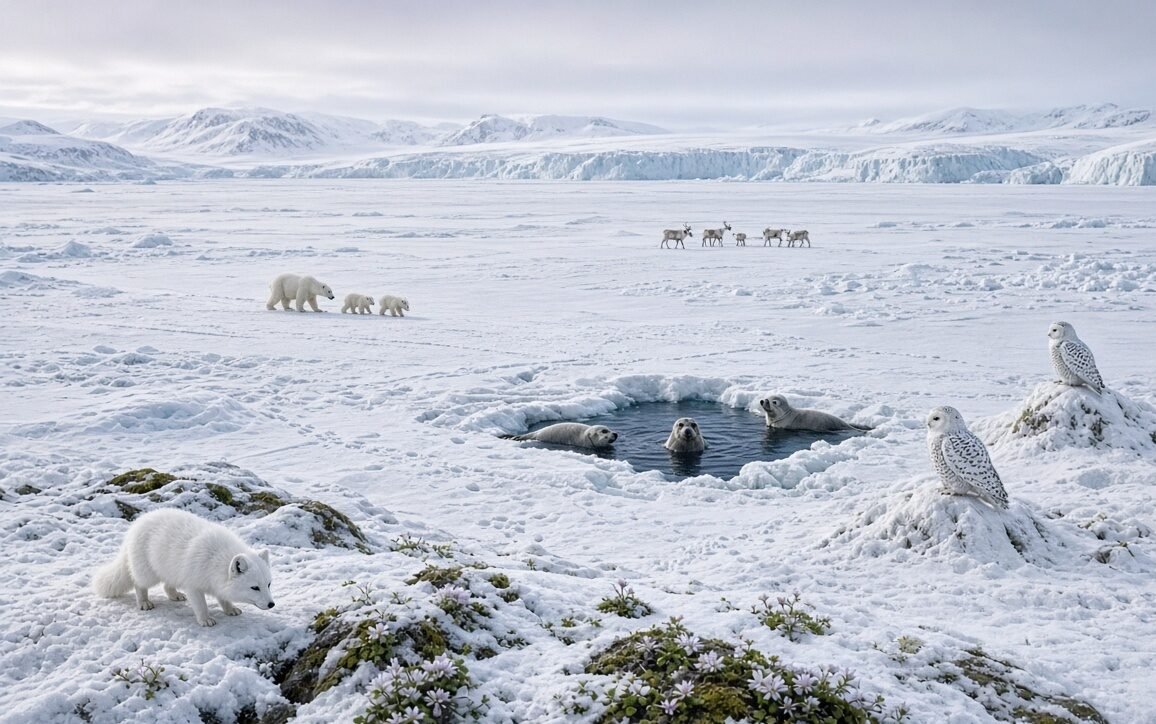
This moving ice is important for animals. Polar bears use sea ice as a platform while hunting seals. Seals also live around the ice. Walruses rest on ice or land, depending on conditions. Many birds arrive during the warmer season when food becomes easier to find.
I used to imagine the Arctic as a silent place with almost no life. That picture is wrong. Life there can be surprisingly rich.
Under the ice, tiny organisms form an important part of the food web. Small marine creatures feed larger animals. Fish feed on smaller organisms. Seals feed on fish and other prey. Polar bears can depend heavily on seals.
Polar bears have thick fur and a layer of body fat. Arctic foxes can change their coat color with the seasons. Reindeer, also called caribou in North America, have adaptations that help them survive cold environments and move across large areas.
I find the Arctic fox especially interesting. Its small body, thick fur, and furry feet help it deal with harsh weather. It can look tiny against the huge Arctic landscape. Yet it is built for a place where survival can be difficult.
The Arctic is also home to people. This is another fact that is sometimes forgotten when the region is shown only through pictures of ice and wild animals.
Indigenous peoples have lived across the Arctic for thousands of years. Communities have developed deep knowledge of local landscapes, weather, animals, sea ice, travel, and seasonal changes. Their cultures are diverse, and their experiences cannot be reduced to one simple Arctic story.
Modern Arctic communities include towns and cities as well as smaller settlements. People work, study, travel, fish, hunt, build businesses, use technology, and maintain traditions. Life in the Arctic is not frozen in the past.
The landscape itself is also unusual. Permafrost is ground that remains frozen for at least two consecutive years. It covers large parts of the Arctic region. Some permafrost contains huge amounts of frozen organic material.
When frozen ground warms and thaws, the land can change. Roads and buildings may face problems. Lakes and wetlands can change too. In some places, the ground can sink or become unstable.
That makes the Arctic important far beyond its own borders.
The Arctic also plays a major role in Earth’s climate system. Snow and ice can reflect a large amount of sunlight back into space. Darker land or open water absorbs more solar energy. This means changes in snow and ice can affect how much heat the region takes in.
This is one reason scientists watch the Arctic closely.
The region has experienced significant warming in recent decades, with changes in sea ice, glaciers, snow cover, permafrost, and ecosystems. The exact effects differ from place to place. Some changes can happen quickly, while others take years to become clear.
I think this is where the Arctic becomes more than a beautiful travel story. What happens there can influence people living far away.
The Arctic Ocean is another reason the region is unique. It is the smallest and shallowest of the world’s five recognized oceans. Much of it is surrounded by land. Its waters connect with the Atlantic and Pacific oceans through different passages.
The ocean is not simply a frozen surface. Beneath the sea ice, water moves, animals travel, and marine ecosystems function. The ice itself can be several meters thick in some locations, while other areas may have thinner seasonal ice.
The Arctic also has some of the planet’s most unusual weather. Cold air can dominate for long periods, but temperatures can vary greatly by season and location. Coastal areas can experience different conditions from areas deep inland.
Snow does not always mean the same thing everywhere. Some Arctic areas receive surprisingly little precipitation. Parts of the polar region can be classified as desert because of their low precipitation.
That sounds strange at first. A place covered with snow being called a desert seems impossible. Yet a desert is defined by dryness, not simply by heat.
The Arctic landscape can also be incredibly colorful. Summer brings flowers, green plants, mosses, grasses, and shrubs to places that look lifeless during winter. The short growing season can become a burst of activity.
Animals respond quickly to the changing season. Migratory birds arrive in large numbers. Insects appear. Plants grow rapidly. Herbivores search for fresh vegetation. Predators follow their prey.
For a short time, the Arctic can feel almost busy.
Then winter slowly takes control again.
Another famous Arctic feature is the aurora borealis, or northern lights. These glowing curtains and waves appear when charged particles from the Sun interact with Earth’s upper atmosphere. The colors can include green, pink, purple, and red.
I think seeing the northern lights would make the Arctic feel almost unreal. The landscape is dark. The air can be extremely cold. Then the sky suddenly appears to move.
But the Arctic is not only about dramatic scenery.
It is also a place of scientific discovery. Researchers study ice, oceans, wildlife, atmosphere, geology, climate, and human communities. Ice cores can preserve clues about Earth’s past climate. Animals can reveal how ecosystems respond to environmental changes.
Scientists also use satellites, aircraft, ships, sensors, and field stations to understand the region.
The Arctic is difficult to study because the environment is challenging. Extreme cold can damage equipment. Sea ice can move. Storms can arrive quickly. Winter darkness can make fieldwork harder.
Yet researchers continue to visit and monitor the region because the information found there can help explain changes across the planet.
There is also growing interest in Arctic shipping and natural resources. As sea ice conditions change, some northern routes can become more accessible for certain periods. Countries and businesses have shown interest in transportation, minerals, energy, and other resources.
But increased activity also brings questions.
The Arctic is a fragile environment. An accident involving a ship, fuel, or industrial operation can be difficult to manage in remote areas. Wildlife can also be affected by noise, pollution, habitat changes, and increased human activity.
That is why the Arctic’s future is being watched carefully.
For me, the biggest surprise is that the Arctic is not one simple place. It is many worlds connected together.
Every part tells a different story.
A change in sea ice is not just a change in ice. It can affect animals, food chains, communities, ocean conditions, and climate patterns.
That is what makes the Arctic truly unique.
It may look like a distant white corner of the planet. But it is active, living, changing, and deeply connected to the rest of Earth.
As of August 16, 2026, interest in the Arctic continues to grow because the region sits at the center of important environmental, scientific, cultural, and economic questions. I see it as a place where the past, present, and future meet.
The Arctic may be cold, but its story is far from frozen.
✍️ Written by Vimal Bhagat
🌎 Sharing fresh news, trending stories & interesting updates from around the world.
💙 Read more: arcticcircle.us