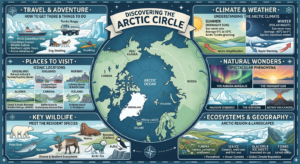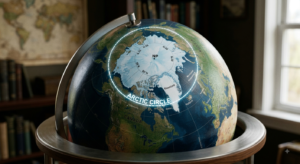
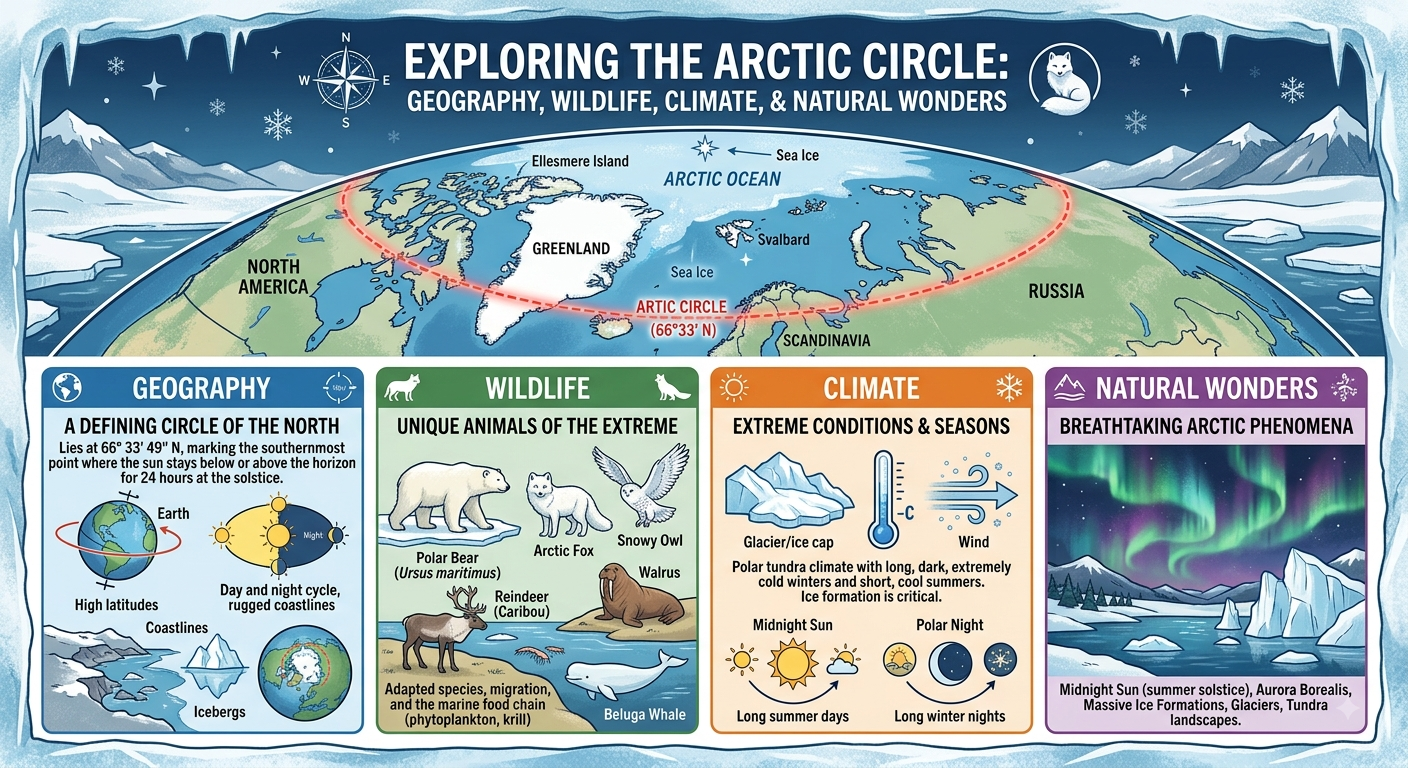
The Arctic Circle is one of the most remarkable geographical boundaries on Earth. Located in the Northern Hemisphere at roughly 66.5° north latitude, it marks the southern limit of a region where the Sun can remain above the horizon for at least one full day in summer and below it for at least one full day in winter. This unusual relationship between Earth’s tilt and its orbit creates some of the planet’s most distinctive natural phenomena.
But the Arctic Circle is much more than an imaginary line on a map. It surrounds a vast polar region of frozen seas, tundra, mountains, glaciers, and remote islands. It is home to highly adapted Arctic wildlife, Indigenous communities with deep connections to the land, and ecosystems that play an important role in the global climate system. Its landscapes and natural phenomena also make it an extraordinary destination for travelers and scientists.
Introduction to the Arctic Circle
What Is the Arctic Circle?
The Arctic Circle is an imaginary line that circles the Earth at approximately 66.5° north latitude. Its exact position changes slightly over time because Earth’s axis slowly shifts.
The line crosses parts of several countries, including Norway, Sweden, Finland, Russia, the United States through Alaska, Canada, Denmark through Greenland, and Iceland. Much of the area north of the line consists of ocean and sea ice, while large sections of land are covered by tundra and other cold-environment landscapes.
Why Is the Arctic Circle Unique?
The Arctic Circle is special because of Earth’s approximately 23.5-degree axial tilt. As Earth travels around the Sun, this tilt causes the Arctic region to experience dramatic seasonal differences in daylight.
Near the Arctic Circle, the summer can bring a period when the Sun barely sets, while winter can bring days when it does not rise above the horizon. Farther north, these periods become longer, producing the famous Midnight Sun and polar night.
These conditions influence almost every aspect of Arctic life, from plant growth and animal behavior to human activities and travel.
Geography and Climate
A Landscape of Ice, Snow, and Tundra
The Arctic region contains a remarkable mixture of landscapes. Frozen seas surround vast stretches of land, while glaciers, mountains, rocky coastlines, wetlands, and tundra create a complex environment.
The Arctic tundra is especially distinctive. It generally lacks tall trees because the growing season is short and the ground may remain frozen beneath the surface. Instead, mosses, lichens, grasses, flowering plants, and low shrubs survive close to the ground.
Sea ice is another defining feature. It forms when seawater freezes during the colder months and expands across parts of the Arctic Ocean. In summer, much of this seasonal ice melts, although some sea ice remains year-round.
Extreme Temperatures and Seasons
The Arctic climate is shaped by low solar angles, long winters, and strong seasonal contrasts. Winters can be extremely cold, particularly over the interior land areas, while coastal locations are influenced by the comparatively warmer Arctic Ocean.
Summer may appear short, but continuous or nearly continuous daylight provides plants with an intense growing period. This brief season supports an unexpected burst of biological activity, including flowering plants, insects, birds, and grazing animals.
Wildlife and Ecology
The Arctic ecosystem supports animals that have evolved remarkable strategies for surviving cold, darkness, limited food, and seasonal change.
Polar Bears and Arctic Foxes
The polar bear is one of the best-known symbols of the Arctic. It is strongly associated with sea ice, where it hunts seals and travels between feeding areas. Its thick fur and substantial layer of body fat help it withstand extremely cold conditions.
The Arctic fox has a different survival strategy. Its compact body, dense fur, and furry paws help reduce heat loss. Its coat also changes with the seasons, providing camouflage against different backgrounds.
Reindeer, Caribou, Seals, and Whales
Reindeer and caribou are important herbivores in northern ecosystems. Their movements can cover enormous distances as they search for vegetation and respond to seasonal conditions.
Seals are closely connected to Arctic sea ice and marine environments. Several species use ice as resting or breeding habitat. Arctic waters also support whales, including bowhead whales, belugas, narwhals, and several migratory species that travel north during productive summer months.
Migratory Birds
During summer, the Arctic becomes a temporary home for millions of migratory birds. Species arrive from distant parts of the world to take advantage of abundant insects, plants, and long daylight hours.
This seasonal migration demonstrates how closely connected the Arctic is to ecosystems far beyond the polar region.
People and Life in the Arctic
Indigenous Communities
The Arctic has been home to Indigenous peoples for thousands of years. Communities including Inuit, Sámi, Nenets, Chukchi, and many others have developed diverse cultures and traditions adapted to northern environments.
Their knowledge of weather, animals, ice, landscapes, and seasonal patterns has been passed between generations. Although Arctic communities differ greatly from one another, many maintain strong cultural relationships with the natural environment.
Traditional and Modern Life
Traditional activities in different Arctic societies have included hunting, fishing, herding, gathering, and traveling across snow and ice. Today, modern infrastructure, education, technology, communications, and changing economies have transformed everyday life.
At the same time, many communities face challenges connected with environmental change, economic pressures, infrastructure limitations, and the rising costs of living in remote northern areas.
Climate Change in the Arctic
The Arctic is among the regions experiencing some of the most significant effects of a warming planet. Rising temperatures are contributing to changes in sea ice, glaciers, snow cover, permafrost, ecosystems, and coastal environments.
Melting Sea Ice
Declining sea ice can affect animals that depend on it for feeding, resting, or breeding. Changes in ice conditions can also affect Indigenous travel routes and traditional activities.
Less reflective ice can create additional warming because open water absorbs more solar energy than bright ice surfaces. This is one reason Arctic changes can have broader climate implications.
Why the Arctic Matters Globally
Although the Arctic may seem distant from most populated regions, changes there can influence the wider Earth system. Melting glaciers and land ice contribute to sea-level rise, while changes in snow and ice affect how much solar energy Earth reflects.
Scientists also monitor permafrost because thawing frozen ground can alter landscapes and ecosystems and release greenhouse gases that have been stored in frozen soils.
Northern Lights and Other Natural Wonders
The Aurora Borealis
The Northern Lights, or aurora borealis, are among the Arctic’s most spectacular natural phenomena. They occur when charged particles associated with the Sun interact with gases in Earth’s upper atmosphere.
The result can be waves and curtains of green, pink, purple, or other colors moving across the night sky. The best viewing opportunities generally occur during dark, clear conditions away from artificial light.
The Midnight Sun
The Midnight Sun is almost the opposite experience. During summer, locations north of the Arctic Circle can experience periods when the Sun remains visible around midnight.
This unusual daylight changes the rhythm of life. Travelers can hike, photograph landscapes, or explore communities late into the evening under natural light.
Visiting the Arctic Circle
Arctic travel offers experiences that are difficult to find elsewhere. Popular destinations include northern Norway, Finnish Lapland, Swedish Lapland, Iceland, Greenland, Alaska, and northern Canada.
Visitors may enjoy:
- Northern Lights tours
- Dog sledding and snowmobile excursions
- Wildlife watching
- Snowshoeing and winter hiking
- Reindeer experiences
- Arctic cruises
- Midnight Sun photography
- Visits to Indigenous cultural sites and communities
Travelers should prepare carefully for cold conditions and rapidly changing weather. Responsible tourism is particularly important because many Arctic environments are fragile and remote.
Conservation and the Future
Protecting the Arctic Circle and its surrounding ecosystems requires cooperation among governments, scientists, Indigenous communities, conservation organizations, businesses, and travelers.
Wildlife conservation programs help protect vulnerable species and habitats. Scientific research provides information about changing temperatures, sea ice, ocean conditions, wildlife populations, and permafrost.
Sustainable Arctic Tourism
Tourism can provide economic opportunities for northern communities, but it needs to be carefully managed. Responsible visitors should respect wildlife, follow local guidance, reduce waste, avoid disturbing sensitive habitats, and support local businesses where possible.
The future of the Arctic will depend partly on how effectively societies address global climate change while supporting the people who already live in the region.
Conclusion
The Arctic Circle is special because it brings together extraordinary geography, extreme seasonal light, resilient wildlife, ancient cultures, and globally important environmental processes. Its frozen seas and tundra support species uniquely adapted to polar conditions, while phenomena such as the Northern Lights and Midnight Sun reveal the remarkable relationship between Earth, the Sun, and its atmosphere.
At the same time, the Arctic is changing rapidly. Understanding and protecting this region is important not only for polar wildlife and Arctic communities but for the wider planet. Whether viewed through the lens of science, conservation, culture, or Arctic travel, the Arctic Circle remains one of Earth’s most fascinating and important regions.
✍️ Written by Vimal Bhagat
🌎 Sharing fresh news, trending stories & interesting updates from around the world.
💙 Read more: arcticcircle.us