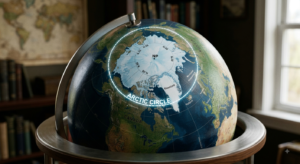
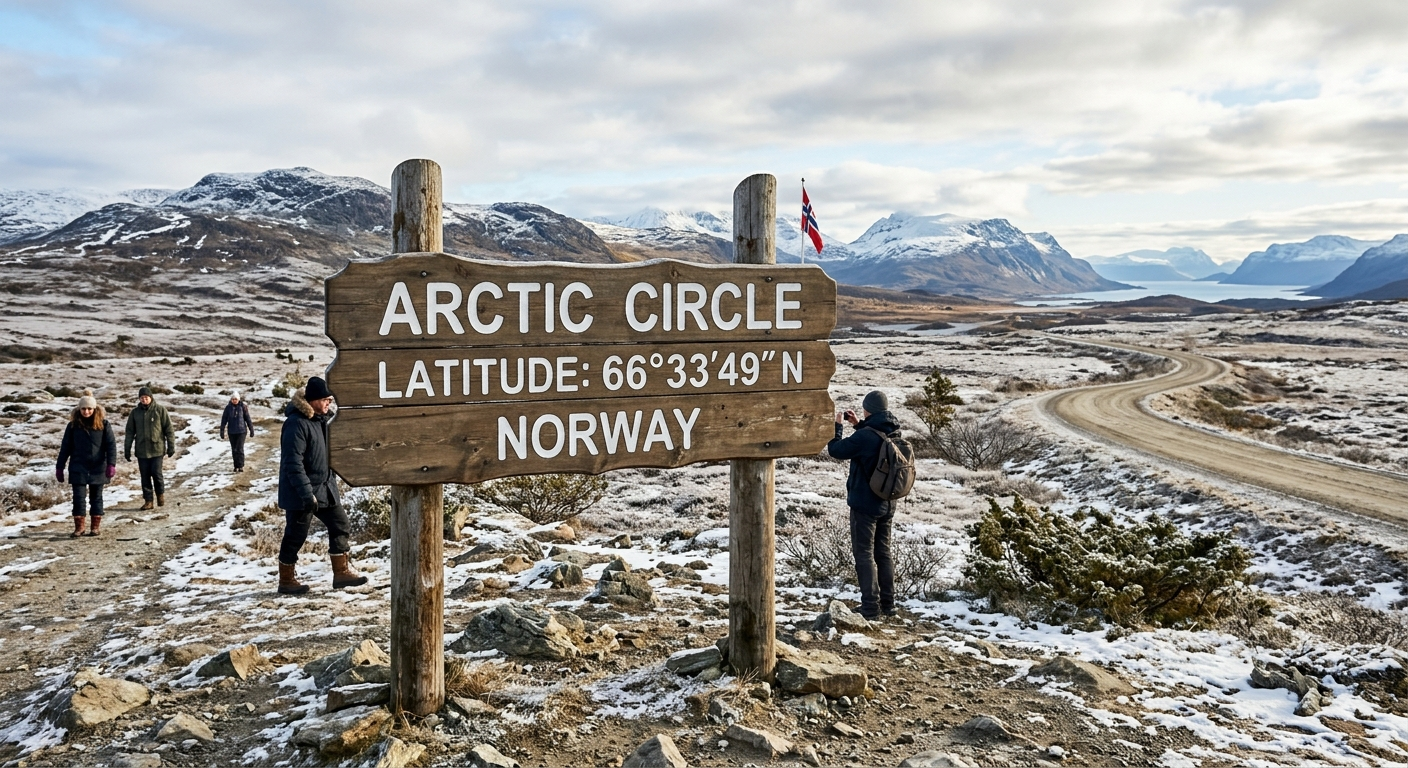
Arctic Circle latitude is drawing fresh attention on August 16, 2026, as people look again at the strange line that wraps around the far north. I keep finding it amazing because this is not just a line on a map, it changes what the Sun can do. The Arctic Circle is generally placed near 66°33′ north, though its exact position shifts a little as Earth’s tilt changes.
I first think of latitude as simple map numbers. But the Arctic Circle latitude is where geography suddenly feels like a sky story. At this line, or north of it, the Sun can stay above the horizon for a full 24 hours in summer, and below it for a full 24 hours in winter.
That sounds almost made up, but it is real. I would expect night to come after evening like it does everywhere else. Up here, sometimes evening just keeps going and going, and the dark forgot to arrive.
The reason starts with Earth itself. Our planet does not stand perfectly straight while it travels around the Sun. Earth is tilted, and that small-looking tilt creates the seasons and also creates the famous midnight Sun and polar night.
The Arctic Circle sits about 66.5 degrees north of the Equator. That means it is roughly 23.5 degrees away from the North Pole, which sits at 90 degrees north. The number is not random at all, it is closely connected with Earth’s axial tilt.
I find that part especially interesting. A line that looks quiet on a map is actually connected to the position of the whole planet. Move farther north, and the unusual daylight becomes stronger.
Near the Arctic Circle, the effect is at its smallest. A place just north of the line can get about one day each year when the Sun does not set, and another when it does not rise. Go much farther north, and those strange periods become longer.
At the North Pole itself, the story becomes huge. The Sun can remain above the horizon for roughly half the year and below it for roughly the other half. That is why the Arctic Circle is only the beginning of the polar daylight story, not the end.
I sometimes imagine standing on that invisible line. There would be no giant wall. No glowing border in the sky. The line exists because humans use latitude to describe a place on Earth, yet its effect can be seen high above our heads.
Maps make the Arctic Circle look perfectly neat. Nature is less tidy than that. The exact latitude is not frozen forever, because Earth’s orientation changes slightly, so the circle moves a little over time.
That tiny movement matters to people who like exact numbers. Many maps and guides round the Arctic Circle latitude to 66.5°N or 66°33′N. More precise values can be written with seconds, and the number changes slightly depending on the date and the reference used.
I think this is why the Arctic Circle can be confusing. One website may say 66.5 degrees north. Another may write 66°33′. A more exact source may give several seconds after the minutes. They are generally describing the same famous circle, with different levels of precision.
The Arctic Circle crosses several parts of the northern world. It passes through areas of Norway, Sweden, Finland, Russia, Alaska, Canada and Greenland, as well as Arctic waters. These places are very different from one another, but the same basic sunlight rule connects them.
I was surprised by how much the line means to travel. People visit Arctic Circle markers to take photographs, stand with one foot on each side, and tell friends that they have crossed into the Arctic. Some markers are simple signs, while others become major tourist attractions.
In Finland, for example, the Arctic Circle is closely linked with the tourism around Rovaniemi. The line is promoted as a memorable place to cross, and visitors often connect it with Lapland, winter scenery and the Christmas season. The geography is real, even when the tourism around it becomes playful.
But the sunlight is the bigger story. During northern summer, places above the Arctic Circle can experience the midnight Sun. The Sun may sit low near the horizon instead of disappearing completely.
I think that can confuse visitors. Midnight does not suddenly become bright like noon. The Sun can appear low, soft and strange, making the landscape look like evening that never finishes. In some places, people can still see bright skies long after the clock says midnight.
In Iceland, the situation shows why latitude matters so much. Iceland lies mostly south of the Arctic Circle, with the circle passing near its northern edge at Grímsey Island. Reykjavík is around 64.1°N, below the Arctic Circle, so it does not experience the same full 24-hour midnight Sun rule as locations north of the line.
That little difference in latitude changes the experience. A map can show only a few degrees. On the ground, those degrees can mean a very different night.
Winter brings the opposite event. The same basic geometry that gives endless summer daylight can produce polar night in winter. North of the Arctic Circle, there can be a period when the Sun stays below the horizon for at least 24 hours.
I think people often hear “polar night” and imagine complete darkness for months everywhere in the Arctic. That is not quite right. The length and character of darkness depends strongly on how far north a place is.
Close to the Arctic Circle, the period is much shorter. Farther north, it becomes longer. Near the North Pole, the change becomes extreme, with the Sun remaining absent for a very long stretch.
The sky can still show some light even when the Sun itself is below the horizon. Twilight can brighten the horizon around certain times. Weather, clouds, mountains and atmospheric conditions can make the view look different from one day to another.
This is where the Arctic Circle latitude becomes more than a geography fact. It is a marker for a giant natural clock. The line tells us roughly where Earth’s tilt allows a full day without sunset in summer and a full day without sunrise in winter.
The cause is not that the Arctic suddenly becomes closer to the Sun in summer. That is an easy idea to get wrong. The main reason is Earth’s tilt and the way different parts of the planet face toward or away from the Sun during the yearly journey around it.
During northern summer, the Northern Hemisphere tilts toward the Sun. Areas far north can stay in sunlight even as Earth rotates. The ground turns into the night side, then keeps turning, but the Sun still does not drop fully below the horizon.
During northern winter, the geometry reverses. The far north tilts away from the Sun. The same rotation that normally creates day and night cannot bring the Sun high enough above the horizon.
I like that strange balance. One season gives too much daylight. The other gives too little. Earth keeps moving, and the pattern returns every year.
The Arctic Circle is also one of the five major circles of latitude on Earth. It has a southern partner called the Antarctic Circle. Both sit at roughly 66.5 degrees from the Equator, but one is in the Northern Hemisphere and the other is in the Southern Hemisphere.
The Equator is at 0 degrees latitude. The North Pole is at 90 degrees north. Between them, the Arctic Circle marks a major geographic threshold.
Latitude itself is simply a way to describe how far north or south a location is from the Equator. Lines of latitude run around Earth from east to west. They help maps, navigation systems, scientists and travelers understand where places sit on the planet.
The Arctic Circle is therefore not a country border. It is not a physical fence. It is not an edge where the landscape suddenly changes.
That part matters, because the word “circle” can sound like a visible object. It is an imaginary geographic line. Still, its consequences are very physical.
Animals do not stop at it because a map says so. Snow does not know where the line is. Ocean water does not carry a painted border. But the sunlight pattern gives the line its special importance.
The Arctic region itself can be defined in several different ways too. Some definitions use latitude, while others use climate, vegetation or other environmental features. So the Arctic Circle and the Arctic region are related, but they are not always exactly the same thing.
I think that is another small detail people miss. Saying “north of the Arctic Circle” is a geographic statement. Saying “inside the Arctic” can depend on which definition is being used.
Modern maps make it easy to locate the line. Digital maps can show coordinates down to tiny fractions of a degree. Yet the old mystery remains, because knowing the number does not make the sunlight feel any less strange.
Travelers in Alaska can experience this directly. The Dalton Highway, for example, reaches the Arctic Circle north of Fairbanks, and recent travel reports have continued to describe journeys toward the line. One 2026 motorcycle report described a ride along the Dalton Highway to the Arctic Circle, showing how the latitude remains a destination as well as a geographic measurement.
In Norway, Sweden and Finland, the line also appears in roads, signs and tourist locations. Russia and Canada contain enormous areas north of the circle. Greenland reaches far beyond it toward the North Pole.
So when I see “Arctic Circle latitude” in a search, I do not see just one number anymore. I see a line tied to sunlight, seasons, maps, travel and the shape of Earth itself.
The exact value deserves one more look. A commonly cited value is about 66°33′ north. Some sources give 66°33′45.9″, while others round it to about 66.5°N. The difference is mainly precision, not a disagreement about where the Arctic Circle is.
And the line shifts. Earth’s axial tilt changes gradually, so the Arctic Circle does not remain at one perfectly identical coordinate through all time. That movement is small in everyday life, but it is important when scientists and cartographers work with precise coordinates.
Today, on August 16, the Northern Hemisphere is still in summer. The Arctic has passed the June solstice, when northern daylight reaches its annual extreme, and the gradual return toward shorter days is underway. In northern locations, however, the days can still remain exceptionally long.
That seasonal change is easy to forget when looking at a static map. A map may show one line forever. The real Arctic keeps changing with the movement of Earth.
I think that is the real surprise hidden inside this simple keyword. Arctic Circle latitude sounds like a school geography term. But behind those few numbers is one of the biggest natural light shows on the planet.
The line tells a story without speaking. North of it, summer can bring a Sun that refuses to disappear. Winter can bring a Sun that refuses to rise.
And that is why this quiet latitude keeps attracting attention. It sits on paper as 66.5 degrees north, but in real life it marks a place where the normal rules of day and night begin to look wonderfully strange.
✍️ Written by Vimal Bhagat
🌎 Sharing fresh news, trending stories & interesting updates from around the world.
💙 Read more: arcticcircle.us