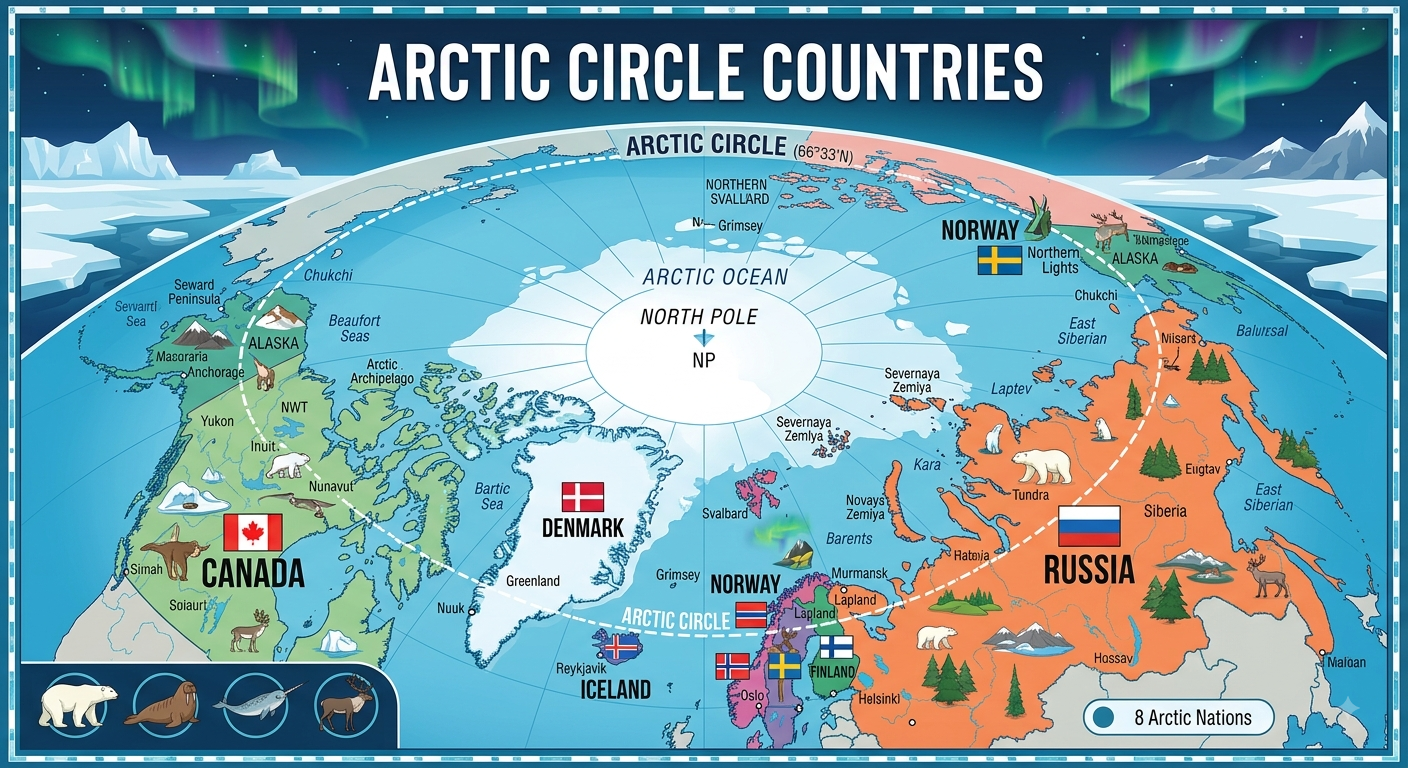
Introduction to the Arctic Circle
The Arctic Circle is one of the most fascinating geographic boundaries on Earth. It marks the southern limit of a region where, at least once each year, the Sun can remain above the horizon for a full 24 hours. In winter, the opposite can occur: the Sun may stay below the horizon for an entire day. This unusual pattern of daylight and darkness makes the Arctic region unlike almost anywhere else on the planet.
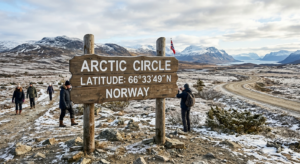
The Arctic Circle lies at approximately 66°34′ north latitude, although its exact position changes gradually because Earth’s axial tilt is not perfectly constant. It crosses parts of several countries and passes through the Arctic Ocean, islands, tundra, forests, and remote communities.
The region is important far beyond its dramatic scenery. The Arctic climate influences global weather and ocean systems, while its sea ice, glaciers, tundra, and wildlife form a highly specialized Arctic ecosystem. The Arctic is also home to Indigenous peoples whose cultures and livelihoods have developed in close relationship with the northern environment.
What Is the Arctic Circle?
The Arctic Circle is an imaginary line around the Northern Hemisphere. It is one of the five major circles of latitude used to describe Earth’s geography.
It passes through areas of:
- Norway
- Sweden
- Finland
- Russia
- the United States, through Alaska
- Canada
- Denmark, through Greenland
- Iceland, through the island of Grímsey
These are commonly described as the countries or states with territory north of the Arctic Circle. The line itself does not define the entire Arctic region, however. Scientific and political definitions of the Arctic can extend farther south or north depending on whether researchers use climate, vegetation, oceanographic, or administrative boundaries.
Latitude and the Northern Hemisphere
The Arctic Circle is located in the Northern Hemisphere at roughly 66.5 degrees north. Its position is directly related to Earth’s approximately 23.4-degree axial tilt.
Because Earth is tilted as it travels around the Sun, locations north of the Arctic Circle experience at least one day of continuous daylight and one day of continuous darkness each year. The farther north a place is located, the longer these periods can last.
Geography and Climate
The Arctic landscape is remarkably diverse. Although people often imagine a landscape covered entirely by snow and ice, the Arctic includes mountains, coastal plains, tundra, wetlands, glaciers, islands, and areas of boreal forest near its southern edges.
Ice, Snow, Tundra, and Frozen Seas
Sea ice is a defining feature of the polar region. It forms when seawater freezes and expands across parts of the Arctic Ocean during the colder months. In summer, much of this seasonal ice melts.
On land, permafrost—ground that remains frozen for long periods—supports distinctive ecosystems and creates challenges for buildings, roads, and other infrastructure. Arctic tundra is generally treeless and contains low-growing plants such as mosses, lichens, grasses, and shrubs.
Extreme Temperatures
The Arctic climate is shaped by low solar energy, long winters, ocean currents, winds, and the reflective effect of snow and ice. Winters can be extremely cold, particularly in the continental interior, while coastal areas may experience milder conditions because of the influence of the ocean.
Summer is often cool compared with lower latitudes, but continuous sunlight can produce surprisingly productive growing seasons for plants and insects.
Polar Day and Polar Night
One of the Arctic’s most remarkable natural features is the changing length of daylight.
During the polar day, the Sun does not set for at least 24 hours. Near the North Pole, continuous daylight lasts for months. During the polar night, the Sun remains below the horizon for an extended period.
These conditions strongly influence wildlife behavior, vegetation, transportation, tourism, and everyday life.
Wildlife and Ecology
Arctic wildlife has evolved to cope with cold temperatures, seasonal food supplies, powerful winds, and long periods of darkness.
Polar Bears and Arctic Foxes
The polar bear is one of the best-known Arctic animals. It is highly adapted to life around sea ice, where it hunts marine mammals and travels between feeding areas. Because sea ice is crucial to its habitat, changes in ice conditions can affect polar bear populations and behavior.
The Arctic fox has a different survival strategy. Its thick fur provides insulation, and its coat changes color seasonally in many populations, helping it blend into snowy winter landscapes and darker summer terrain.
Reindeer, Caribou, Seals, and Whales
Reindeer, known as caribou in North America, travel across large distances in search of food. Their migrations are among the most impressive movements of land mammals.
Seals depend on marine environments for food, breeding, and resting. Arctic waters also support whales such as bowhead whales, belugas, and narwhals.
Migratory birds arrive in enormous numbers during the short Arctic summer. The abundance of insects and plants during this season provides an important source of food before many birds travel thousands of kilometers south again.
Arctic species survive through adaptations including dense insulation, specialized body shapes, seasonal migration, food-storage behavior, and the ability to function under extreme seasonal light conditions.
People and Life in the Arctic
The Arctic is not an empty wilderness. Millions of people live across the wider Arctic region, including numerous Indigenous communities with long histories in the north.
Indigenous peoples such as the Inuit, Sámi, Chukchi, Nenets, and many other groups have developed diverse cultures and traditions suited to local environments. Hunting, fishing, herding, gathering, craftsmanship, and trade have historically played important roles in many communities, although modern Arctic life also includes schools, businesses, technology, government services, and other contemporary activities.
Traditional knowledge remains valuable for understanding weather, animals, ice conditions, landscapes, and seasonal changes. At the same time, Arctic communities face modern challenges including changing climate conditions, rising costs, infrastructure difficulties, and pressures on traditional livelihoods.
Climate Change in the Arctic
The Arctic is experiencing some of the most significant effects of global warming. Air temperatures have increased, glaciers and ice sheets are losing mass, and the extent and characteristics of Arctic sea ice are changing.
These changes affect more than polar bears and seals. Alterations to sea ice can influence marine food webs, coastal ecosystems, shipping conditions, and communities that depend on predictable ice and weather.
Melting land ice also contributes to global sea-level rise. In addition, the loss of bright snow and ice surfaces reduces Earth’s ability to reflect incoming sunlight, allowing darker ocean and land surfaces to absorb more heat.
What happens in the Arctic matters to the rest of the world because the polar region is connected to the global climate system. Researchers continue to study how Arctic changes may influence atmospheric circulation, ocean processes, ecosystems, and weather patterns farther south.
Northern Lights and Other Natural Wonders
The Northern Lights, or Aurora Borealis, are among the Arctic’s most spectacular attractions. They occur when energetic particles associated with the Sun interact with Earth’s upper atmosphere, producing glowing curtains and arcs of green, pink, purple, and other colors.
Another extraordinary experience is the midnight Sun. During the appropriate season, the Sun remains visible around midnight, creating long periods of golden or bright daylight.
Snow-covered mountains, frozen lakes, coastal landscapes, glaciers, and wide-open tundra add to the appeal of the region. Together, these natural features make the Arctic a destination for travelers seeking unusual landscapes and seasonal experiences.
Visiting the Arctic Circle
Arctic travel has grown in popularity, with destinations across Scandinavia, Alaska, Canada, Greenland, Iceland, and northern Russia offering different experiences. Accessibility varies greatly between locations, and some areas are far more remote than others.
Popular activities can include:
- Watching the Northern Lights
- Dog sledding
- Snowmobiling and other winter activities
- Wildlife watching
- Visiting Indigenous cultural sites
- Hiking during the summer
- Experiencing the midnight Sun
- Exploring Arctic museums and scientific attractions
Travelers should plan carefully because weather can change quickly, transportation may be limited, and winter conditions can be demanding. Appropriate clothing, reliable local guides, travel insurance, and respect for local communities and wildlife are particularly important.
Responsible Arctic travel also means keeping a safe distance from animals, avoiding damage to fragile vegetation, following local regulations, and choosing operators that take environmental protection seriously.
Conservation and the Future
Protecting the Arctic ecosystem is increasingly important as environmental pressures grow. Conservation efforts focus on wildlife habitats, marine environments, migratory routes, coastal ecosystems, and the preservation of Indigenous cultures and livelihoods.
Scientific research is another essential part of the Arctic’s future. Researchers monitor sea ice, glaciers, wildlife populations, ocean temperatures, permafrost, and atmospheric conditions. Long-term observations help scientists understand changes that may have consequences far beyond the Arctic region.
Sustainable tourism can also contribute when it is carefully managed. Visitors can support local businesses, respect cultural traditions, reduce waste, and choose experiences designed to minimize environmental impact.
The future of the Arctic will depend on decisions made both within the region and around the world. Limiting greenhouse gas emissions is central to reducing long-term climate risks, while local adaptation and conservation can help communities and ecosystems cope with changes that are already occurring.
Conclusion
The Arctic Circle is far more than an imaginary line on a map. It is a gateway to a distinctive world of sea ice, tundra, mountains, unusual daylight, remarkable wildlife, and resilient communities.
The countries and territories touched by the Arctic Circle share a connection to one of Earth’s most sensitive environments, yet each has its own landscapes, cultures, and experiences. From the Northern Lights and midnight Sun to polar bears and migrating birds, the region offers extraordinary natural wonders.
At the same time, the Arctic is a vital center for climate research and environmental observation. Understanding its changing ice, ecosystems, and communities helps the world better understand the future of the planet. Whether viewed through science, conservation, culture, or Arctic travel, the Arctic Circle remains one of Earth’s most important and fascinating regions.
✍️ Written by Vimal Bhagat
🌎 Sharing fresh news, trending stories & interesting updates from around the world.
💙 Read more: arcticcircle.us