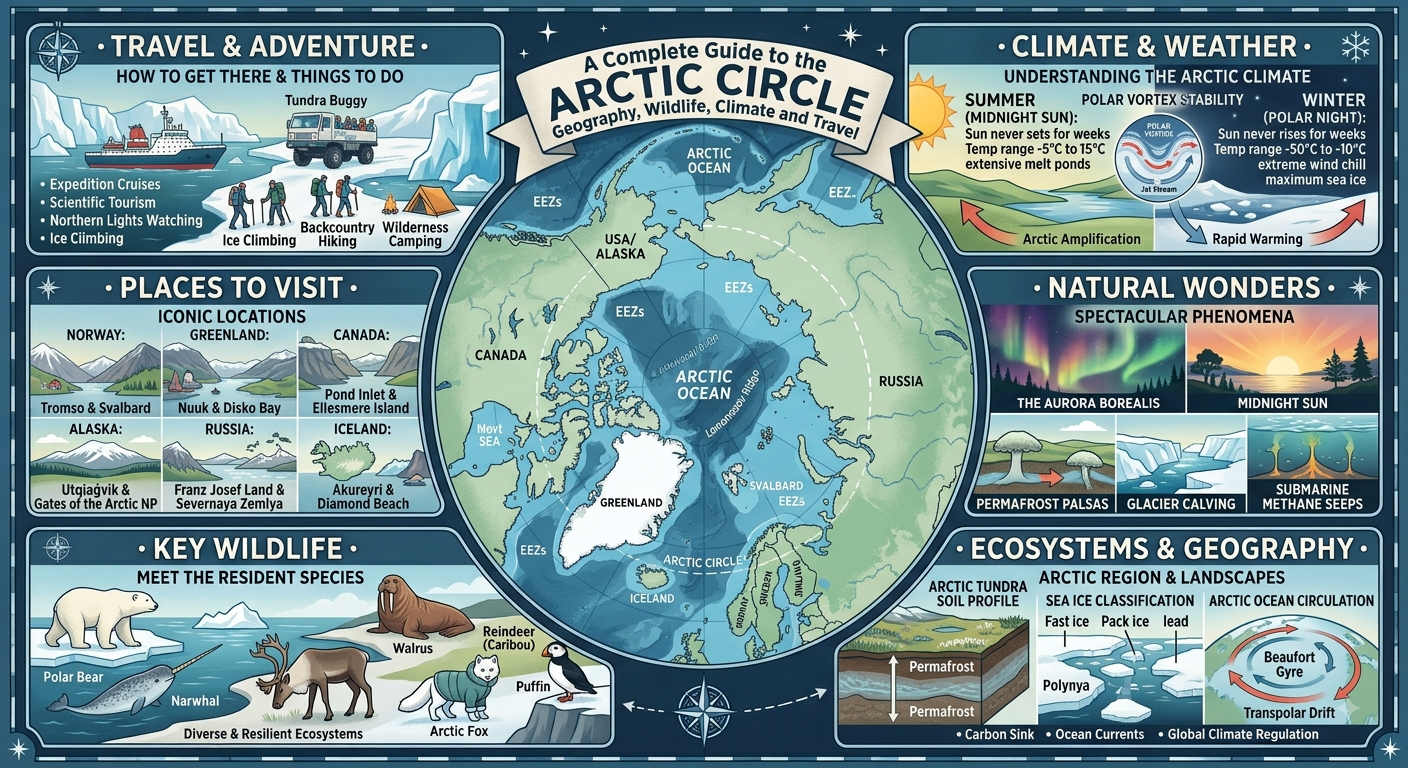
The Arctic Circle is one of the most fascinating regions on Earth—a vast northern zone shaped by ice, snow, tundra, ocean, and extraordinary seasonal changes in sunlight. Located around the northern part of the planet, it crosses several countries and includes landscapes ranging from frozen seas and glaciers to forests and open tundra. Beyond its dramatic scenery, the Arctic region is scientifically important because changes taking place here can influence ecosystems and climate far beyond the polar region.
For travelers, the Arctic Circle offers rare experiences such as seeing the Northern Lights, walking beneath the Midnight Sun, observing Arctic wildlife, and learning about communities that have adapted to northern environments for generations. At the same time, the region is undergoing rapid environmental change, making it an important focus of modern climate research and conservation.
Introduction to the Arctic Circle
What Is the Arctic Circle?
The Arctic Circle is an imaginary line of latitude located at approximately 66.5 degrees north of the Equator. It marks the southern boundary of an area where, at least once each year, the Sun can remain above the horizon for 24 hours and, during another part of the year, remain below it for 24 hours.
The Arctic Circle passes through parts of countries including Norway, Sweden, Finland, Russia, the United States, Canada, Denmark through Greenland, and Iceland. Its exact position changes gradually because Earth’s axial tilt is not completely fixed.
The region north of this latitude is often associated with the wider Arctic, although the scientific definition of the Arctic can vary depending on whether temperature, vegetation, ocean conditions, or political boundaries are being considered.
Why Is the Arctic Circle Unique?
Few places experience such dramatic seasonal differences in daylight. During summer, communities above the Arctic Circle can experience the Midnight Sun, when daylight continues through the night. In winter, the opposite phenomenon, known as the Polar Night, brings extended periods without the Sun rising above the horizon.
These unusual light conditions influence wildlife behavior, vegetation, transportation, tourism, and everyday life.
Geography and Climate
An Arctic Landscape of Ice and Tundra
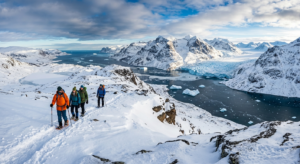
The Arctic landscape is remarkably diverse. Although images of endless ice often dominate popular descriptions, the region also contains tundra, mountains, glaciers, rivers, lakes, wetlands, islands, and coastal environments.
The Arctic Ocean is surrounded by land across much of its southern boundary. Seasonal sea ice forms over large areas of the ocean during the colder months and retreats during warmer periods. Sea ice is much more than frozen seawater: it reflects solar energy, influences exchanges between the ocean and atmosphere, and provides important habitat for marine organisms.
The tundra is another defining feature. Trees are scarce or absent in much of the high Arctic because of cold temperatures, short growing seasons, and frozen ground. Mosses, lichens, grasses, sedges, and small flowering plants can nevertheless survive during the brief summer.
Extreme Temperatures and Seasonal Light
The Arctic climate is characterized by long, cold winters and short summers. Conditions vary considerably from one location to another, with coastal areas often experiencing different temperatures from inland regions.
The seasonal cycle of sunlight is particularly remarkable. Near the Arctic Circle, the period of continuous daylight or darkness is relatively short compared with locations farther north. As one travels closer to the North Pole, these periods become longer.
Wildlife and Ecology
Despite its harsh environment, the Arctic ecosystem supports an impressive variety of life. The Arctic Council identifies more than 21,000 known species of cold-adapted animals, plants, fungi, and microorganisms.
Polar Bears and Arctic Foxes
The polar bear is perhaps the best-known symbol of Arctic wildlife. It is highly adapted to a marine environment and depends heavily on sea ice for important parts of its life cycle.
The Arctic fox has a different strategy for surviving the cold. Its thick fur provides insulation, while seasonal changes in coat color help it blend into snowy and snow-free environments.
Reindeer, Caribou, Seals and Whales
Reindeer, known as caribou in North America, travel across enormous areas in search of food. Their seasonal movements are closely connected with tundra vegetation and changing environmental conditions.
Arctic waters support several species of seals and whales. Walruses, narwhals, beluga whales, and bowhead whales are among the marine animals associated with northern seas.
Migratory birds also play an important role. Many species travel thousands of kilometers to the Arctic during summer, taking advantage of abundant seasonal food and long hours of daylight.
How Arctic Species Survive
Arctic animals use many strategies to cope with extreme conditions. Thick fur, layers of body fat, seasonal migration, changes in metabolism, specialized feeding behavior, and careful timing of reproduction all contribute to survival.
These adaptations, however, do not make species immune to environmental change. Rapid shifts in temperature, sea ice, snow, vegetation, and food availability can disrupt relationships that developed over thousands of years.
People and Life in the Arctic
The Arctic is not an empty wilderness. Nearly four million people live across the broader Arctic region, including Indigenous Peoples, rural residents, hunters, herders, and people living in towns and cities.
Indigenous Communities and Traditional Knowledge
Indigenous communities have developed deep cultural, economic, and spiritual relationships with the Arctic environment. Hunting, fishing, herding, gathering, crafts, storytelling, and knowledge of seasonal conditions have traditionally been important parts of life in many communities.
Traditional and local knowledge remains valuable today. The Arctic Council recognizes its importance alongside scientific research when understanding environmental changes and developing practical solutions.
Modern Challenges
Life in northern communities can be affected by limited transportation, high living costs, changing weather, infrastructure difficulties, and environmental change. Changes in sea ice and snow can also affect travel routes, hunting, fishing, and access to traditional foods.
Climate change therefore represents not only an environmental issue but also a social and cultural challenge for Arctic residents.
Climate Change in the Arctic
The Arctic has become one of the clearest indicators of a changing climate. According to the Arctic Council, Arctic temperatures are rising at roughly three times the global annual average.
Melting Sea Ice
Satellite observations show long-term declines in Arctic sea ice. NOAA’s 2025 Arctic Report Card reported the lowest annual maximum sea-ice extent in the 47-year satellite record in March 2025, followed by the tenth-lowest September minimum.
Less sea ice can affect animals that depend on frozen surfaces, alter marine ecosystems, and make some Arctic waters more accessible to ships.
Why Arctic Changes Matter Globally
The Arctic is connected to the rest of Earth’s climate system. Snow and ice reflect incoming sunlight, while darker ocean and land surfaces absorb more energy. Changes in the Arctic can therefore influence heat exchange and environmental processes on a much larger scale.
Climate change is also affecting Arctic communities, wildlife habitats, freshwater systems, infrastructure, transportation, and food security.
Northern Lights and Other Natural Wonders
Aurora Borealis
The Northern Lights, or Aurora Borealis, are among the Arctic’s most famous natural spectacles. They occur when energetic particles associated with the Sun interact with gases in Earth’s upper atmosphere, producing glowing curtains and arcs of light.
Dark winter skies make many Arctic destinations excellent places to experience the aurora, although visibility depends on factors such as cloud cover, solar activity, location, and light pollution.
Midnight Sun
The Midnight Sun creates another unforgettable experience. During part of the Arctic summer, the Sun remains visible around midnight, producing long periods of natural daylight.
For visitors, this can transform ordinary activities into unusual adventures. Hiking, photography, sightseeing, and wildlife watching can continue late into the evening under a bright sky.
Visiting the Arctic Circle
Popular Arctic Destinations
Travelers can experience the Arctic in many different ways. Popular destinations include northern Norway, Swedish and Finnish Lapland, Iceland, Greenland, Alaska, northern Canada, and parts of northern Russia.
Each destination offers its own combination of landscapes, wildlife, cultural experiences, and seasonal activities.
Experiences for Arctic Travelers
Depending on the destination and season, visitors may enjoy:
- Wildlife watching and nature photography
- Northern Lights tours
- Dog sledding
- Snowshoeing and cross-country skiing
- Snowmobile excursions
- Glacier and tundra excursions
- Cultural experiences with local and Indigenous communities
- Hiking beneath the Midnight Sun
Arctic travel requires careful planning. Weather can change quickly, distances may be large, and some locations have limited services or transportation. Travelers should follow local safety guidance and choose responsible operators.
Tourism can provide valuable economic opportunities, but it can also place pressure on fragile landscapes and small communities. The Arctic Council specifically promotes environmentally and culturally sustainable tourism as part of responsible Arctic development.
Conservation and the Future
Protecting the Arctic requires cooperation between governments, scientists, Indigenous communities, conservation organizations, businesses, and travelers.
Wildlife conservation is especially important because many Arctic species depend on habitats that are changing rapidly. Protecting important breeding grounds, migration routes, marine habitats, and tundra ecosystems can help maintain biodiversity.
Scientific research is equally important. Researchers monitor sea ice, temperatures, wildlife populations, ocean conditions, pollution, and other environmental indicators. The Arctic Council coordinates extensive monitoring and assessment work to improve understanding of changes throughout the region.
Sustainable tourism can also contribute when visitors respect wildlife, minimize waste, follow designated routes, support local businesses, and learn about Arctic cultures without treating communities or traditions as attractions.
Conclusion
The Arctic Circle is far more than a geographical line on a map. It is a living region where ice, ocean, tundra, wildlife, people, and climate interact in remarkable ways. Its polar day and polar night create unusual rhythms of life, while the Northern Lights and vast landscapes make it one of the world’s most memorable travel destinations.
At the same time, the Arctic is changing rapidly. Declining sea ice, rising temperatures, shifting ecosystems, and challenges for northern communities demonstrate why this region matters far beyond its borders. Understanding and protecting the Arctic Circle is therefore important not only for polar wildlife and the people who call the North home, but also for the future of Earth’s wider climate system.