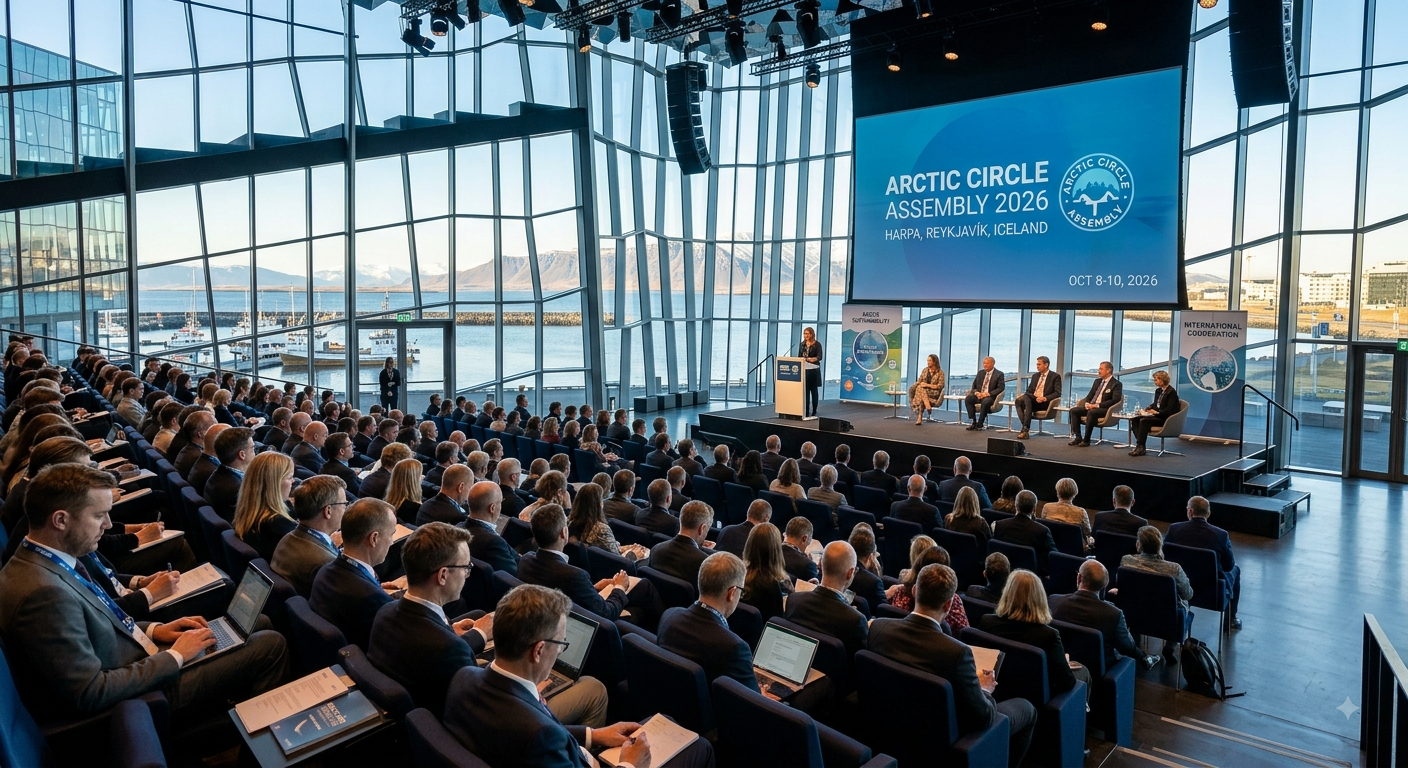
Arctic Circle Assembly is suddenly back in the spotlight, and I can already feel the buzz building. As of Sunday, August 16, 2026, the big meeting is still weeks away, but Reykjavík is getting ready for the October gathering. The 2026 event is scheduled for October 8–10 at Harpa Concert Hall and Conference Centre in Reykjavík, Iceland.
I keep seeing the same big question pop up: what will happen when so many Arctic voices get into one room? This is not just a cold-weather meeting, no way. Governments, scientists, Indigenous representatives, companies, universities, environmental groups and many other people are expected to join the talks. The event is known as one of the biggest international gatherings focused on Arctic affairs.
And here is where it gets interesting. The Arctic Circle Assembly is not only about the Arctic itself. The region affects weather, oceans, energy, shipping, climate policy and global security. So, what happens in Reykjavík can have a much bigger story behind it. I find that part rather wild, because a meeting in Iceland can quickly become a conversation about the whole planet.
The 2026 Assembly is expected to bring more than 2,500 participants from over 70 countries. That is a lot of people, a lot of microphones, and probably a lot of strong opinions too. The official event information describes the Assembly as a place for international engagement, cooperation and discussion about the future of the Arctic and the planet.
I would not call it a simple conference. It feels more like a giant meeting point where politics, science, business and climate concerns all bump into each other. One person may arrive with a research paper. Another may arrive with a government plan. Someone else may arrive wanting stronger action on climate change. Then, suddenly, everyone is talking about the same northern region.
The Arctic has become a very different political story in recent years. Climate change remains a huge issue. Security is also getting more attention. Energy matters. New technology matters. Shipping matters. Indigenous rights matter. And the future of Arctic communities matters most of all, because these are not just abstract ideas for people living in the North.
The 2025 Assembly showed how wide the conversation has become. More than 3,000 delegates gathered in Reykjavík that year, with defence and security concerns taking a major place in the discussions. That tells me something important about the mood around the Arctic. Climate is still central, but security is no longer sitting quietly in the corner.
In October 2025, NATO Military Committee Chairman Admiral Giuseppe Cavo Dragone also addressed the Assembly. Icelandic and NATO officials were discussing defence cooperation in the North Atlantic and Arctic regions during the same period. It was one more sign that the Arctic conversation has become closely linked with international security.
Then there is the climate side, which never really leaves the room. Iceland has watched its glaciers change dramatically. At the 2023 Assembly, former Icelandic Prime Minister Katrín Jakobsdóttir spoke strongly about climate change and the melting of Arctic ice and glaciers. She also warned about setbacks in climate action and gender equality.
I think that is why the Assembly gets so much attention. The conversations can be serious, but they are also connected. Climate affects communities. Climate affects oceans. Oceans affect economies. Economies affect politics. Politics affects security. One topic walks into another, almost like somebody opened every door at once.
The 2026 programme is therefore being watched with interest. The event information says discussions will cover areas including science, governance, security, economics, investment, oceans and sustainable development. That sounds broad, but the Arctic itself is broad. You cannot really talk about its future using just one subject.
There is also a strong research angle. Universities and scientific institutions use the Assembly to present new ideas and discuss Arctic research. That can sound a little dry, I know, but the science can become very important later. A small study about ice, wildlife, oceans or communities may eventually influence a much bigger policy decision.
And then business walks in.
Companies are increasingly interested in the Arctic because the region has resources, transport routes, technology opportunities and energy questions. But business activity in the North is not as simple as saying, “There is an opportunity, let us go.” The Arctic has fragile ecosystems and communities with long histories in the region. Any major development can bring arguments about environmental protection, economic growth and local rights.
That is where Indigenous representatives have an especially important place. The Assembly is designed to include Indigenous Peoples and organizations alongside governments, academics, businesses and civil society. I think this makes the discussion much more real. The Arctic is not an empty white space on a map. People live there. Families work there. Cultures have grown there for generations.
The international mix is another thing people are watching. In 2025, Singaporean Minister of State Gan Siow Huang attended the Assembly and spoke about the global effects of Arctic warming. She highlighted Singapore’s own climate adaptation efforts and its interest in Arctic research and ocean governance.
That story is a little surprising at first.
Singapore is far from the Arctic, yet it has a reason to care. Arctic warming does not politely stay inside Arctic borders. Changes in ice and oceans can have effects far beyond the far North. So countries far away are increasingly joining Arctic conversations. I think that is one of the most interesting parts of the Assembly.
The 2026 meeting also arrives at a time when Iceland itself is paying close attention to Arctic diplomacy. In April 2026, Iceland appointed Hlynur Guðjónsson, a former ambassador to Canada, as its Senior Arctic Official to the Arctic Council. His responsibilities include managing Iceland’s interests in Arctic Council work and wider Arctic cooperation.
That gives the coming Assembly another little layer of intrigue. Iceland is not just hosting people in a beautiful concert hall. It is also playing an active role in Arctic affairs. Reykjavík can become a place where formal talks happen, but informal conversations can happen too. And sometimes, those hallway conversations are the ones people remember.
Registration for the 2026 Assembly has opened, according to event information published in July. The gathering will run from October 8 to October 10 at Harpa in Reykjavík. Another event listing also confirms the October 8–10 dates and Reykjavík location.
So the countdown has started.
There is still time before the doors open, but the shape of the event is already becoming clear. It will bring together people who may agree on one issue and completely disagree on another. Others will be looking at investment and business.
And I suspect there will be plenty of moments where the room gets very serious.
The Arctic is changing fast, and nobody seems able to ignore it anymore. Ice loss, warming temperatures and changing ecosystems have pushed the region into a much bigger global conversation. At the same time, geopolitical tensions have made the Arctic important from a security point of view. The two stories now sit side by side.
That mix can make the Assembly fascinating.
I also think the event’s open format is part of its appeal. The Arctic Circle organization describes itself as a nonprofit and nonpartisan platform that brings together governments, businesses, research institutions, universities, Indigenous representatives, environmental groups, think tanks and civil society. It is a strange combination sometimes, but maybe that is exactly the point.
Different people see the Arctic differently.
A scientist may see melting ice.
A fisherman may see a changing ocean.
A government may see security.
A company may see an investment.
An Indigenous community may see home.
All of those views can exist at the same time.
That is why I will be watching the October meeting closely. The most interesting news may not come from the biggest speech. It could come from a new research project, a surprising partnership, a sharp disagreement or a quiet meeting between officials.
The Arctic Circle Assembly has grown into a place where those things can happen.
And the 2026 edition arrives with plenty of questions waiting for answers. And perhaps the biggest question of all: can countries with very different interests still find ways to cooperate?
I do not have the answers yet.
Nobody does.
But that is what makes the coming Assembly worth watching.
By October, Reykjavík will once again become a meeting point for people thinking about one of the fastest-changing regions on Earth. The weather outside may be cold, but inside Harpa, the conversations are likely to be anything but quiet.
The Arctic Circle Assembly 2026 is still ahead.
The headlines are not here yet.
But the gossip around the big Arctic meeting has already started.
✍️ Written by Vimal Bhagat
🌎 Sharing fresh news, trending stories & interesting updates from around the world.
💙 Read more: arcticcircle.us