Introduction to the Arctic Circle
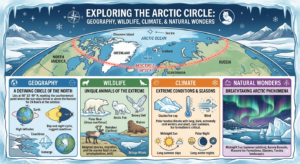
The Arctic Circle is one of the most remarkable geographic boundaries on Earth. Located at approximately 66.5° north latitude, it stretches across the Northern Hemisphere and passes through parts of several countries, including Norway, Sweden, Finland, Russia, Canada, the United States, Greenland, and Iceland. Beyond this imaginary line lies a vast polar region shaped by cold temperatures, seasonal darkness, sea ice, tundra, mountains, and extraordinary wildlife.
What makes the Arctic Circle especially fascinating is the way geography influences life. During part of the year, some locations experience the Midnight Sun, when the Sun remains above the horizon for days or even weeks. During winter, the opposite occurs: the polar night brings extended periods without direct sunlight.
The Arctic is also an important environmental indicator. Changes in Arctic climate, particularly the loss of sea ice and warming temperatures, can influence ecosystems and climate patterns far beyond the polar region. At the same time, the Arctic remains home to communities whose cultures and livelihoods have developed alongside this challenging but productive environment.
Geography and Climate of the Arctic Circle
A Landscape of Ice, Snow, and Tundra
The Arctic landscape is far more diverse than a simple image of endless snow. It includes frozen seas, coastal wetlands, rocky mountains, glaciers, rivers, lakes, and expansive tundra.
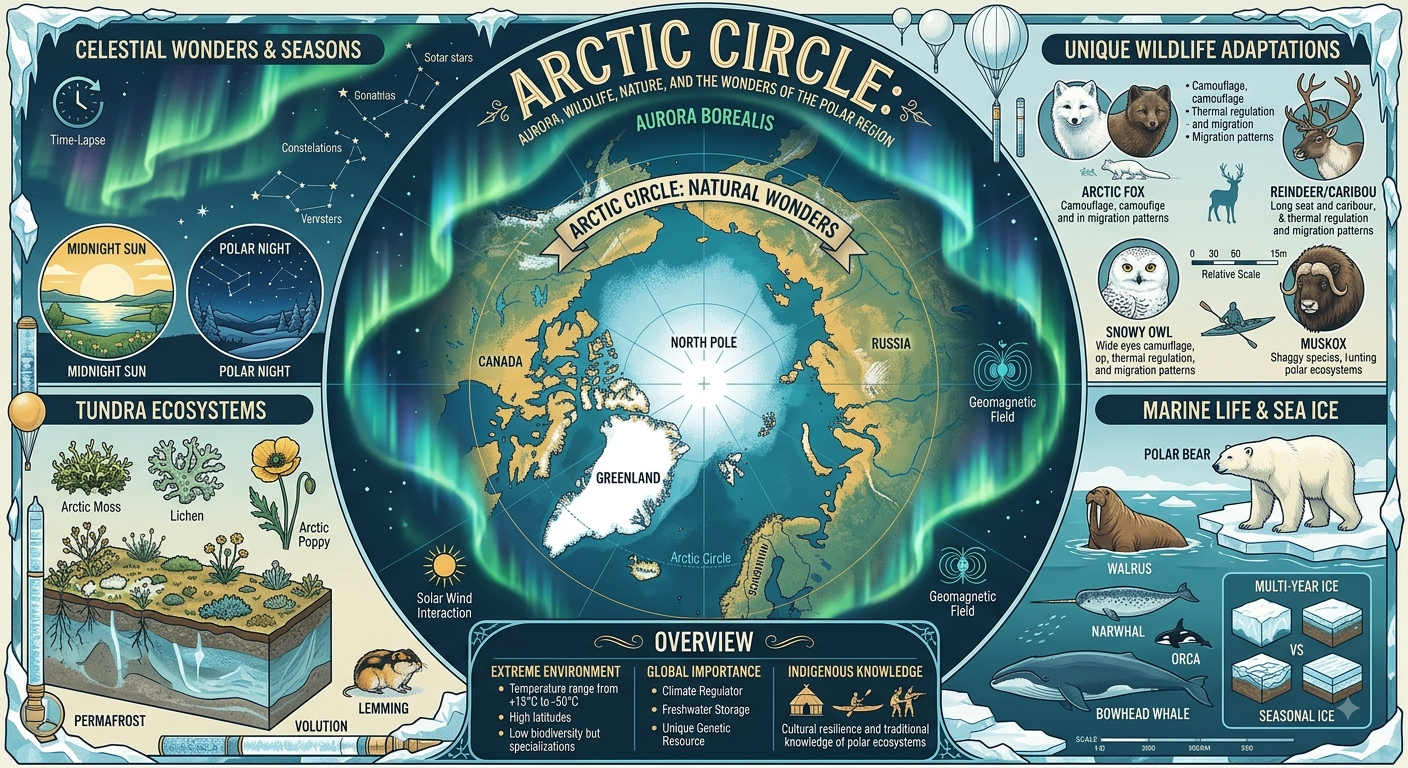
The tundra is characterized by a short growing season and permanently frozen ground, known as permafrost, in many areas. Trees are generally scarce because of the cold climate and limited growing season. Instead, mosses, lichens, grasses, and small flowering plants provide important food and shelter for Arctic wildlife.
Sea ice is another defining feature. Each winter, large areas of the Arctic Ocean freeze, while much of this ice melts or retreats during summer. The seasonal rhythm of freezing and melting affects marine ecosystems, weather, transportation, and wildlife.
Extreme Seasons
The Arctic climate varies considerably from one location to another. Coastal areas can experience somewhat milder conditions than the interior, while high-latitude regions can experience extremely low winter temperatures.
One of the Arctic’s most distinctive characteristics is its unusual pattern of daylight. North of the Arctic Circle, the Sun does not set for at least one day during summer and does not rise for at least one day during winter. The closer a location is to the North Pole, the longer these periods become.
Wildlife and Ecology
The Arctic ecosystem supports animals specially adapted to cold, seasonal food supplies, and long periods of darkness.
Polar Bears and Arctic Foxes
The polar bear is perhaps the best-known Arctic animal. It is highly adapted to life around sea ice, where it hunts seals and uses the frozen environment as a platform for movement and feeding.
The Arctic fox has another impressive survival strategy. Its thick seasonal coat provides insulation during winter, while its compact body, small ears, and furry paws help reduce heat loss. Its coat also changes color in many populations, helping it blend into different seasonal landscapes.
Reindeer, Seals, and Whales
Reindeer, known as caribou in North America, are among the Arctic’s important land mammals. Their migrations can cover enormous distances, and they play a significant ecological and cultural role.
Seals depend heavily on marine environments and sea ice. Species such as ringed seals are particularly important within Arctic food webs and are also closely connected to polar bear diets.
The surrounding seas support several whale species, including belugas, narwhals, bowhead whales, and other marine mammals. These animals rely on productive Arctic waters where seasonal sunlight supports the growth of microscopic organisms at the foundation of marine food chains.
Migratory Birds
Birdlife in the Arctic is surprisingly abundant during summer. Millions of migratory birds travel north to take advantage of long daylight hours and seasonal food resources. Shorebirds, seabirds, geese, ducks, and other species arrive to breed before returning south as winter approaches.
This seasonal migration demonstrates how closely the Arctic ecosystem is connected with environments across the globe.
People and Life in the Arctic
The Arctic is not an uninhabited wilderness. It has been home to Indigenous peoples for thousands of years, including Inuit, Sámi, and numerous other communities across the circumpolar north.
Traditional Knowledge and Lifestyles
Traditional Arctic lifestyles have often depended on hunting, fishing, herding, gathering, and close observation of seasonal environmental changes. In many communities, knowledge about animals, weather, sea ice, plants, and travel conditions has been passed from generation to generation.
Reindeer herding remains an important cultural practice among some Sámi communities, while Inuit communities have deep knowledge of marine environments, sea ice, and Arctic wildlife.
Modern Arctic life combines traditional knowledge with contemporary education, technology, transportation, communications, and economic activities. Communities also face challenges associated with remote locations, infrastructure, economic change, and rapidly changing environmental conditions.
Climate Change in the Arctic
The Arctic is experiencing significant environmental change. Scientists have observed rising temperatures, shrinking sea ice, thawing permafrost, and changes in ecosystems.
Melting Sea Ice
Sea ice is particularly important because it reflects sunlight and helps regulate the Earth’s climate. When bright ice is replaced by darker ocean water, more solar energy is absorbed by the ocean. This can contribute to further warming.
Reduced sea ice can also affect animals that depend on frozen marine habitats. Polar bears, seals, walruses, and other species may experience changes in feeding, breeding, and movement patterns.
Why Arctic Changes Matter Globally
Although the Arctic is geographically distant from many major population centers, its environmental changes have worldwide significance. Melting ice contributes to sea-level rise when land-based glaciers and ice sheets lose mass, while thawing permafrost can release greenhouse gases.
Changes in the Arctic atmosphere and ocean may also influence broader climate systems. For this reason, researchers closely monitor the region using satellites, field stations, research vessels, and long-term environmental observations.
Northern Lights and Natural Wonders
Aurora Borealis
The Northern Lights, or Aurora Borealis, are among the Arctic’s most spectacular natural phenomena. They occur when energetic particles associated with the Sun interact with Earth’s magnetic field and upper atmosphere.
The result can be curtains, arcs, waves, and ribbons of glowing light across the night sky. Green is common, although pink, red, violet, and other colors can appear under suitable conditions.
The best viewing opportunities generally require dark skies, clear weather, and sufficient auroral activity. This makes remote Arctic locations particularly attractive to visitors seeking an unobstructed view.
The Midnight Sun
The Midnight Sun offers an entirely different experience. During summer, locations north of the Arctic Circle can experience continuous daylight for extended periods.
The phenomenon changes everyday life as well as travel experiences. Visitors can explore landscapes late at night under natural sunlight, while local communities adapt their routines to a dramatically different seasonal rhythm.
Visiting the Arctic Circle
Arctic travel offers opportunities to experience unusual landscapes, wildlife, cultures, and natural phenomena. Popular destinations include northern Norway, Swedish and Finnish Lapland, Iceland, Greenland, northern Canada, and parts of Alaska and Russia.
Travelers may enjoy:
- Northern Lights tours during the darker months
- Dog sledding and snowmobile excursions
- Wildlife watching
- Hiking and nature photography
- Snowshoeing and other winter activities
- Cultural experiences with local and Indigenous communities
- Boat trips and Arctic marine excursions
Timing is important. Winter is generally associated with snow, darkness, and Northern Lights opportunities, while summer provides long daylight hours and easier access to many outdoor landscapes.
Visitors should prepare carefully for rapidly changing weather, cold temperatures, limited daylight in winter, and remote travel conditions. Responsible tourism is equally important. Travelers should respect wildlife, local communities, protected areas, and fragile Arctic environments.
Conservation and the Future
Protecting the Arctic ecosystem requires cooperation among scientists, governments, Indigenous communities, conservation organizations, and travelers.
Wildlife conservation programs help monitor vulnerable species and protect important habitats. Scientific research provides information about sea ice, permafrost, ocean conditions, atmospheric changes, and biodiversity.
Sustainable tourism can also play a role. Small-group travel, responsible wildlife viewing, reducing waste, respecting local customs, and choosing environmentally conscious operators can help minimize pressure on fragile environments.
Indigenous knowledge is another valuable part of Arctic research and environmental management. Local observations accumulated over generations can complement scientific measurements and provide important insights into changing conditions.
The future of the Arctic will depend heavily on how the world responds to climate change. Some environmental changes are already underway, but research, conservation, responsible development, and international cooperation can help protect important habitats and communities.
Conclusion
The Arctic Circle is much more than a line on a map. It is a dynamic region where ice, ocean, tundra, wildlife, people, and atmosphere interact in remarkable ways. From the glowing Northern Lights and Midnight Sun to polar bears, migrating birds, frozen seas, and Indigenous cultures, the Arctic offers a unique window into the natural world.
At the same time, the region provides important lessons about climate change. Protecting Arctic wildlife and ecosystems is not only about preserving a remote landscape; it is part of understanding and responding to environmental changes that affect the entire planet. For scientists, travelers, and nature enthusiasts alike, the Arctic Circle remains one of Earth’s most extraordinary and important regions.
✍️ Written by Vimal Bhagat
🌎 Sharing fresh news, trending stories & interesting updates from around the world.
💙 Read more: https://arcticcircle.us