Arctic so cold is not just a dramatic phrase. It describes a place where the Sun can stay low for months, bright snow sends sunlight back toward space, and cold air can sit above sea ice for long periods. On Monday, August 17, 2026, the Arctic remains one of Earth’s most unusual climate zones, even though the region is not cold every day or in every season.
I think the strangest part is the sunlight. The Sun may be above the horizon for a very long time in Arctic summer, yet its rays arrive at a shallow angle. That means the same sunlight is spread over a larger area than it is near the equator, so less energy reaches each part of the ground. It feels like the Sun is there, but its warmth is weak.
Then winter comes, and the story changes quickly. In parts of the far north, the Sun does not rise for weeks or even months. There is no strong daylight to heat the surface. The ground loses heat into the atmosphere and toward space, while snow and ice cover much of the land and ocean. The cold can become intense, quiet and almost endless.
This is one big reason the Arctic stays cold. The Earth’s tilt changes how sunlight reaches the polar regions. Near the equator, sunlight arrives more directly. Near the Arctic, it comes in at a lower angle. Scientists at the National Snow and Ice Data Center identify the Sun’s angle as a primary reason polar regions are colder than tropical regions.
But sunlight is only one piece of the frozen puzzle. Snow and ice make the situation even more interesting. They are bright surfaces. Bright surfaces reflect a large part of incoming solar energy instead of absorbing it. Scientists call this property albedo.
Fresh snow can reflect more than 80 percent of incoming sunlight. Sea ice also reflects much of the sunlight that reaches it. So even when the Sun is shining, a large amount of its energy is sent away rather than turned into surface heat.
Imagine standing outside with a dark shirt and a white shirt on a sunny day. The darker shirt absorbs more sunlight and can feel hotter. Snow and ice behave in the opposite direction. They act like a huge bright shield. They bounce much of the Sun’s energy away.
And there is another twist. The Arctic Ocean is not simply a giant block of frozen water. Sea ice forms a cover over the ocean. That cover can act like a lid, separating the cold atmosphere from the comparatively warmer water underneath. According to the National Snow and Ice Data Center, air above sea ice can become deeply below freezing while the water below remains close to its freezing point.
So the Arctic can have very cold air above ice while liquid ocean water sits below it. That sounds strange at first. But it makes sense when the ice is seen as a barrier between two very different environments.
The long winter darkness makes things colder still. During polar night, there is little or no sunlight to warm the surface. The Arctic loses heat to space. With no strong solar energy coming in, the balance becomes strongly tilted toward cooling.
Even summer is different there. In some Arctic locations, daylight can continue for 24 hours. Yet a long day does not automatically mean a hot day. The Sun stays relatively low in the sky, and the surface can continue reflecting much of its energy. The Arctic can therefore have sunlight without receiving the same heating effect found farther south.
The cold also changes the way people live. Clothing becomes more than fashion. It becomes protection. Homes, roads, vehicles and equipment must handle temperatures that can be dangerous for people and difficult for machines.
I find the wind especially fascinating. Cold air already feels harsh, but moving air can make the environment feel even more severe. Wind removes heat from exposed skin faster, which is why wind chill matters so much in polar weather.
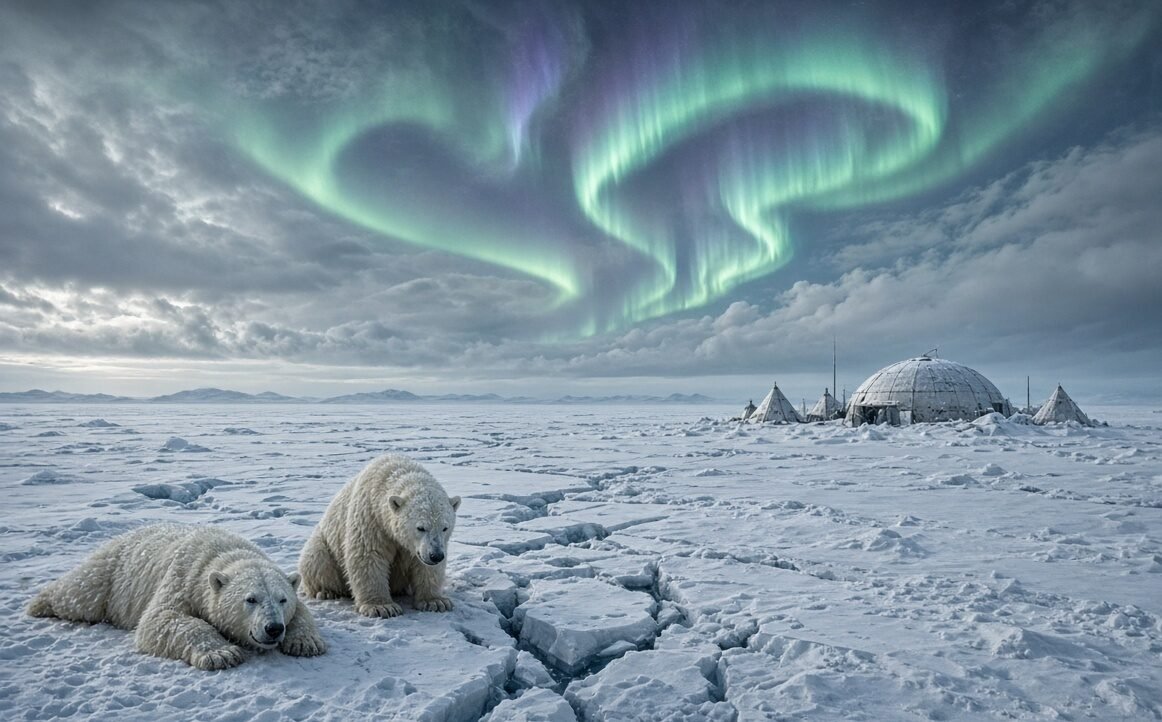
The landscape can look frozen and still, but it is not lifeless. Arctic foxes, reindeer, seals, polar bears and many birds survive in this difficult environment. Their bodies and behavior have adapted to cold, seasonal darkness and limited food.
A polar bear, for example, does not survive simply because it is “tough.” Its body has layers of insulation. Its thick fur and substantial fat reserves help reduce heat loss. Seals also depend on fat and other adaptations to survive cold water.
Plants have their own tricks. Arctic vegetation is often low to the ground. The growing season can be short. Strong winds can be rough. Frozen soil limits roots. Yet mosses, grasses, lichens, small flowering plants and shrubs can still appear when conditions become favorable.
The Arctic is also a place of dramatic seasonal change. In winter, darkness and freezing conditions dominate. In summer, light can remain in the sky for long periods. The contrast is almost unbelievable.
This is why saying the Arctic is “always freezing” can be misleading. The Arctic can experience surprisingly mild or even warm conditions during parts of summer. The region is generally cold compared with most of the world, but its climate varies greatly by location and season. The Arctic Ocean also moderates temperatures compared with the much colder interior of Antarctica.
Still, when winter takes control, the Arctic earns its reputation.
There is also a larger climate story happening now. The Arctic is warming rapidly, and that does not mean its cold has disappeared. Instead, the region is changing while cold conditions can still occur. Recent scientific reporting has highlighted major changes in Arctic sea ice, snow, glaciers and permafrost.
The loss of ice creates an important feedback. When white ice disappears, darker ocean water becomes exposed. Dark water absorbs much more solar energy than bright ice. That extra absorbed energy can contribute to further warming and additional ice loss. Scientists call this the ice-albedo feedback.
It sounds like a simple cycle, but it can have consequences far beyond the Arctic. Changes in Arctic temperature and sea ice can influence atmospheric and oceanic systems. The Arctic is connected to the rest of the planet through moving air, moving water and global climate patterns.
That is why scientists watch the region closely.
The cold itself is also important for research. Scientists study frozen soil, sea ice, glaciers, snow, oceans and wildlife to understand how the Arctic works and how it is changing. Instruments, satellites, ships and research stations help collect information in places that can be extremely difficult to reach.
Working there is not simple. Equipment must function in freezing conditions. Researchers must protect themselves from cold, wind and rapidly changing weather. Even ordinary tasks can become difficult when fingers become numb or machinery is covered with ice.
Recent Arctic operations also show how demanding the environment remains. In August 2026, the Swedish Armed Forces reported advanced medical training in sub-Arctic conditions involving personnel from six NATO countries. The training focused on operating in a cold environment where normal procedures can become harder.
But perhaps the biggest surprise is that the Arctic’s cold is created by a combination of many small effects working together.
The Sun arrives at a low angle. Winter darkness removes solar heating. Snow reflects sunlight. Sea ice changes the exchange of heat between ocean and atmosphere. Cold, dry air can remain near the surface. Winds move heat around. Geography matters too.
None of these facts alone explains everything.
Together, they create the famous Arctic climate.
And the Arctic is not simply a frozen desert sitting at the top of the world. It is an active system. Ocean water moves. Winds race across the landscape. Sea ice grows and breaks. Animals migrate. People travel. Clouds form and disappear. Snow falls, melts and freezes again.
Sometimes the silence makes the place look empty.
It is not.
Under the ice, life continues. In coastal waters, marine animals search for food. Birds use short summer seasons to breed. Reindeer travel across tundra landscapes. Small plants race through their growing season when sunlight becomes available.
Then darkness returns.
The temperature drops. Water freezes. Snow covers the ground. The Arctic begins another long winter cycle.
That cycle has shaped the region for thousands of years. But scientists now see that the cycle is changing because the Arctic is warming. The 2025 Arctic Report Card, for example, recorded the warmest Arctic surface temperatures in the record beginning in 1900 and extremely low winter sea ice.
So the phrase “Arctic so cold” tells only half of the story.
But the bigger story is more surprising.
The Arctic is cold because Earth receives sunlight unevenly. It stays colder because snow and ice reflect energy. Winter darkness removes much of the Sun’s heating power. Sea ice changes how heat moves between ocean and air. And the whole system is shaped by geography and atmospheric circulation.
At the same time, this famous cold region is warming and changing.
That is the Arctic mystery that keeps scientists watching it.
A place known around the world for extreme cold is now also one of the clearest places to observe a changing climate. The ice still shines. The winds still bite. The winter still comes.
But the Arctic itself is no longer quite the same Arctic it was before.
✍️ Written by Vimal Bhagat
🌎 Sharing fresh news, trending stories & interesting updates from around the world.
💙 Read more: arcticcircle.us