
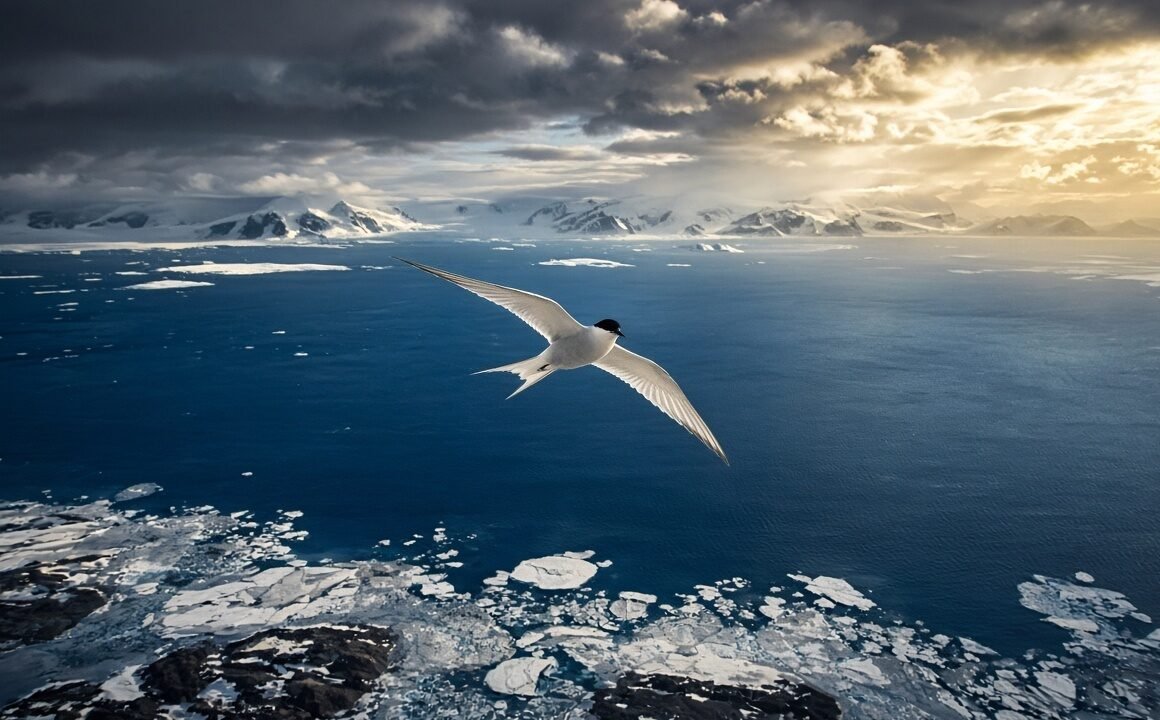
I started watching the Arctic tern migration this week, on August 21, 2026, and the journey still feels almost unbelievable. The tiny bird moves between the far north and the Antarctic, chasing long days and rich feeding waters. New conservation reporting this month is also putting fresh attention on the dangers faced by migratory seabirds as changing oceans and weather reshape their routes.
I always thought a long trip meant thousands of miles, but this bird makes that sound small. The Arctic tern is famous for making one of the longest migrations known in nature. It breeds across Arctic and sub-Arctic regions, then travels south toward Antarctic waters before returning north again. Some tracked birds have covered tens of thousands of kilometres in one yearly cycle, with individual records reaching extraordinary distances.
What surprised me most is the reason behind the trip. The tern is not simply running away from cold. It follows seasonal food and daylight. By moving from the Arctic summer to the Antarctic summer, the bird can experience summer twice in one year. That means more light for feeding, nesting, and survival. It is a strange little trick of nature, and the tern seems very good at it.
I pictured the bird leaving its northern breeding ground. The sky is wide. The sea is cold. Then it starts flying south, often far from land, where people may never see it. Arctic terns can follow complicated ocean routes instead of simply pointing their wings straight toward the other pole. Researchers using tracking devices discovered that birds from different colonies can choose different paths, making the journey even more fascinating.
The famous 2010 tracking study changed how people understood this journey. Researchers tracked Arctic terns from Greenland and found that they could travel from Greenland toward the Antarctic region and back over enormous distances. The British Antarctic Survey described the species as having the longest annual migration known in the animal world.
I keep thinking about the size of the bird. An adult Arctic tern is only a small seabird, with a slender body, narrow wings, and a deeply forked tail. In breeding plumage, it has a dark cap and a red bill. Its appearance is delicate, but its travel plan is anything but delicate. It crosses huge stretches of ocean where there is no road, no sign, and no easy place to stop.
The bird also has a clever food strategy. Arctic terns eat fish and small marine creatures. They can search the ocean while moving between seasonal areas. When breeding begins in the north, food near colonies becomes very important. Later, the southern oceans provide feeding opportunities during the Antarctic summer. The whole migration is tied closely to the rhythm of the sea.
I found one detail especially wild. A tracked Arctic tern from the Farne Islands was recorded traveling about 96,000 kilometres over ten months. That is more than twice around Earth. It did not make a neat straight line, either. The bird crossed large parts of the world’s oceans and moved around the Antarctic region before beginning its return.
That record makes the phrase “long journey” feel almost too weak. I could drive for days and still not understand how a small bird can travel that far. Yet the tern does it as part of its normal yearly life. It flies, feeds, rests when conditions allow, and keeps moving. Nature made this journey look ordinary to the bird.
The migration does not happen as one identical route for every tern. Birds from Greenland can take routes that curve through the Atlantic and toward African or South American waters. Other populations can use different paths. Tracking research has shown that the route can be shaped by wind, ocean conditions, food, and the geography of the seas.
I also learned that the Arctic tern usually stays far offshore outside the breeding season. That explains why such an incredible traveler can remain almost invisible to most people. A bird may be crossing an ocean thousands of kilometres away while people on land are doing normal daily things, with no idea that the journey is happening above or beside them.
The timing is important too. Arctic terns breed during the northern summer. When the northern season changes, the birds begin their southward movement. In the Antarctic region, they arrive during the southern summer. Later, they turn north again. It is like following the sun around the planet, but the route is much more complicated than a simple north-to-south line.
I saw why researchers care so much about this bird. Its journey is not only a record. It is also a moving picture of ocean health. A migrating seabird depends on many places during its lifetime. If one feeding area becomes poor, polluted, disturbed, or difficult to reach, the effects can travel through the bird’s entire yearly cycle.
That concern feels especially current in 2026. A conservation report highlighted this month says migratory seabirds face growing pressure across their marine flyways. Researchers are increasingly looking at the ocean as a connected network rather than treating each breeding colony as a separate place. Protecting one nesting beach may not be enough if birds struggle to find safe food thousands of kilometres away.
Another recent report has raised a wider warning for migratory birds. A review discussed in August 2026 found significant declines among many migratory bird species and pointed to climate change, habitat loss, disease, pesticides, and extreme weather as major pressures. The message is simple, but quite serious: birds need protection throughout their whole journey, not only where they nest.
I think this is where the Arctic tern story becomes bigger than one bird. The tern connects two very distant parts of Earth. Its yearly trip touches Arctic breeding grounds, open oceans, temperate waters, and Antarctic feeding areas. A problem in one part of that system can become a problem somewhere else.
The bird also gives scientists a useful natural signal. When researchers place tracking devices on birds, they can learn where the animals travel, where they stop, and which ocean areas are important. Earlier tracking work showed that Arctic terns can concentrate their movements along particular marine routes instead of wandering randomly across the entire ocean. That information can help conservation planners identify important flyways.
I was surprised to learn how long some Arctic terns can live. The species can survive for many years, meaning one individual may repeat this giant journey again and again. A bird that begins its migration as a young animal could potentially cross the planet many times during its lifetime. The miles keep adding up, year after year.
There is also something almost funny about its name. The Arctic tern spends much of its life traveling between the Arctic and Antarctic, so it is not really staying in one “Arctic” place. Its life is global. It belongs to a world of wind and waves more than borders.
The journey is not always easy. Strong storms can affect flying conditions. Food availability can change. Ocean temperatures and currents can shift. Extreme weather can create problems during migration. Birds also face threats from human activity, including disturbance, pollution, habitat changes, and changes in marine food webs. These pressures can make an already difficult journey harder.
I can imagine the first moment of a young tern leaving its breeding area. It has never completed the full trip before. There is no map in its wing. Still, migration is guided by a combination of inherited behavior, environmental signals, and experience. The bird enters a world much larger than its nesting colony, and somehow it finds its way.
Scientists are still learning exactly how these birds navigate such enormous distances. The story is not completely solved. That makes the Arctic tern even more interesting to me. We know where many birds travel because of modern tracking, but knowing the route is not the same as understanding every decision made along it.
This August, the migration story also arrives at a moment when the health of migratory birds is receiving wider attention. The latest conservation discussion is moving toward international protection of marine flyways because seabirds do not recognize national borders. One bird can cross several countries’ waters and enormous international stretches of ocean during one trip.
I keep coming back to one simple image: a tiny gray-and-white bird above a huge blue ocean. Under it there may be thousands of metres of water. Around it there is wind, rain, and sometimes storms. Ahead is another continent or polar region. Yet it continues.
The Arctic tern migration is therefore not just a story about distance. It is a story about timing, food, daylight, memory, weather, and survival. It shows how connected the Arctic and Antarctic can become through one small animal.
For me, the most exciting part is that the journey is happening again and again, every year. Some birds are moving south. Others are preparing for another stage of their lives. Researchers are watching their routes with better technology than ever before. And conservationists are asking a harder question now: can the oceans and coastlines remain safe enough for these travelers?
The Arctic tern does not know about headlines. It does not know about climate reports. It simply follows the conditions that keep it alive. But its enormous migration can tell us something important. If the journey changes, we should pay attention.
I started with a tiny bird and ended up thinking about the whole planet. That is the real surprise of the Arctic tern migration. The bird may weigh only a little, but the journey it carries is enormous. And every year, somewhere above the world’s oceans, those small wings begin the next unbelievable chapter.
✍️ Written by Vimal Bhagat
🌎 Sharing fresh news, trending stories & interesting updates from around the world.
💙 Read more: arcticcircle.us