Introduction to the Arctic Circle
The Arctic Circle is one of the most remarkable geographical regions on Earth. Located at approximately 66.5° north latitude, it marks the southern boundary of an area where the Sun can remain above the horizon for at least one full day in summer and below it for at least one full day in winter. The circle crosses parts of countries including Canada, Russia, the United States, Greenland, Norway, Sweden, and Finland.
Beyond its unusual geography, the Arctic Circle is important because it connects land, ocean, climate, wildlife, and human communities in a delicate polar environment. It is also becoming increasingly significant for Arctic shipping. As climate change reduces seasonal sea ice in some areas, parts of the Arctic Ocean are becoming more accessible to vessels for longer periods of the year.
Arctic shipping includes commercial cargo transportation, resource-related vessels, passenger ships, research vessels, fishing boats, and support operations. Yet navigating these waters is very different from sailing in warmer regions. Ice, severe weather, limited infrastructure, and environmental sensitivity make Arctic navigation a demanding activity.
Geography and Climate of the Arctic
The Arctic region is centered around the Arctic Ocean and includes extensive coastlines, islands, tundra, glaciers, mountains, and frozen seas. Its geography is shaped by cold temperatures and seasonal changes in sunlight.
Ice, Snow, Tundra, and Frozen Seas
Sea ice is one of the defining features of the Arctic. Unlike glaciers, which form on land, sea ice develops when ocean water freezes. Its extent changes throughout the year, generally reaching a seasonal maximum near the end of winter and a minimum toward the end of summer.
The surrounding land contains tundra vegetation, permafrost, rocky terrain, wetlands, and areas covered by snow and ice. These landscapes create difficult conditions for transportation infrastructure and settlement.
Extreme Temperatures and Polar Light
The Arctic climate is characterized by long, cold winters and short summers. Temperatures vary significantly depending on location, elevation, ocean influence, and season.
The polar day, often called the Midnight Sun, brings continuous daylight during part of summer. In winter, the polar night produces prolonged darkness. These unusual light conditions affect wildlife behavior, human activities, and maritime operations.
For ships, changing daylight and weather conditions can make navigation particularly challenging. Ice forecasts, satellite observations, specialized equipment, and experienced crews are therefore essential.
Arctic Shipping and Major Routes
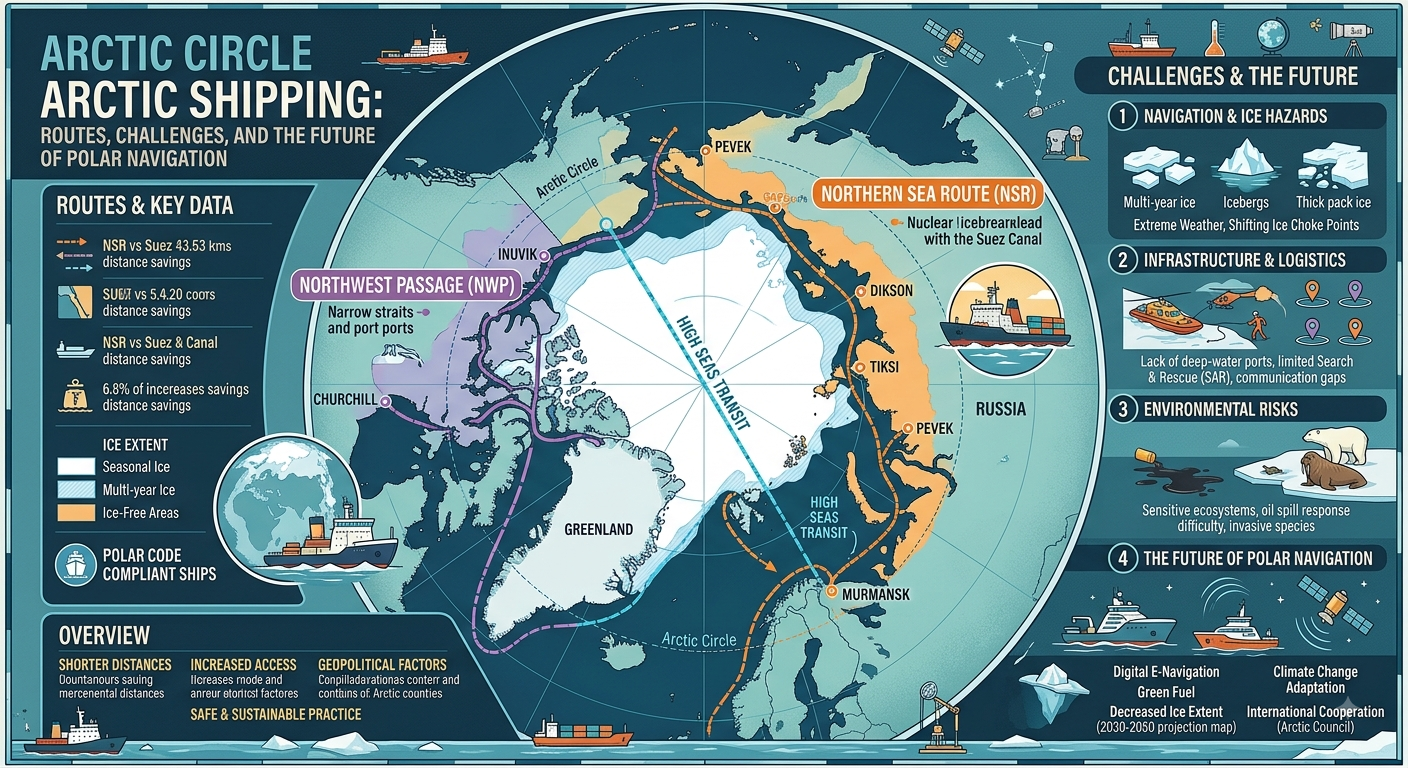
Arctic shipping has attracted growing attention because the region provides several potential maritime routes between the Atlantic and Pacific Oceans.
One of the best-known routes is the Northern Sea Route, which follows the Russian Arctic coastline. Another is the Northwest Passage, a collection of sea routes through the Canadian Arctic Archipelago. Ships can also travel through routes across the central Arctic Ocean, although conditions and accessibility vary greatly.
The potential attraction of Arctic routes is largely related to distance. For some journeys between Europe and Asia, an Arctic route can be shorter than traditional routes through the Suez Canal. However, a shorter distance does not automatically mean a cheaper, safer, or more reliable journey.
Arctic shipping must consider ice conditions, seasonal accessibility, insurance, specialized vessels, fuel requirements, regulations, weather, emergency response, and limited port infrastructure.
Specialized Ships and Navigation
Many vessels operating in icy waters require strengthened hulls and equipment designed for cold environments. Ice-class ships may be built to withstand contact with sea ice, while icebreakers can help maintain passages through difficult conditions.
Modern Arctic navigation also depends on satellite communications, ice charts, weather forecasting, radar, GPS, and other technologies. Even with advanced systems, crews must remain prepared for rapidly changing conditions.
Wildlife and Ecology
The Arctic ecosystem supports species that have evolved to survive extreme cold, seasonal darkness, limited food availability, and changing sea conditions.
Polar bears depend heavily on sea ice for hunting seals and traveling between areas. Arctic foxes survive cold winters with dense fur and behavioral adaptations. Reindeer and caribou travel across large areas in search of food, while seals and whales use Arctic waters for feeding and migration.
Migratory birds also arrive in enormous numbers during the warmer months when food becomes more abundant.
Shipping activity can affect this environment through underwater noise, vessel traffic, pollution risks, and disturbance of wildlife. A serious accident involving fuel or other hazardous materials could be particularly difficult to manage because Arctic conditions can make emergency response slow and complicated.
People and Life in the Arctic
The Arctic is not an empty wilderness. It is home to Indigenous peoples and other communities with long histories of living in northern environments.
Indigenous communities have developed detailed knowledge of seasonal weather, wildlife movements, sea ice, plants, and travel routes. Traditional activities such as fishing, hunting, herding, and gathering remain important in many areas, although lifestyles vary considerably between communities.
Modern Arctic communities also depend on schools, healthcare, transportation, technology, tourism, government services, and commercial industries.
Growing shipping activity can create economic opportunities, including employment and improved transportation links. At the same time, increased vessel traffic can raise concerns about environmental protection, cultural traditions, food security, and disruption to important wildlife areas.
Climate Change in the Arctic
Climate change is one of the most important forces shaping the modern Arctic.
The region has experienced rapid warming, and sea ice has declined significantly over recent decades. Reduced ice can make some waters more accessible to ships during certain seasons, but it does not eliminate the dangers of Arctic navigation.
Thinner or less extensive sea ice can also create unpredictable conditions. Large pieces of drifting ice, storms, fog, and changing currents can still present serious risks.
Why Arctic Changes Matter Globally
Changes in the Arctic extend far beyond the polar region. The Arctic climate influences ocean circulation, atmospheric patterns, sea levels, ecosystems, and global climate systems.
The loss of sea ice also reduces the bright surface that reflects sunlight back into space. Darker ocean water absorbs more solar energy, contributing to additional warming.
For this reason, Arctic shipping should not be viewed only as a transportation issue. It is part of a much larger discussion about climate change, environmental protection, energy use, and international cooperation.
Northern Lights and Other Natural Wonders
The Arctic Circle is famous for extraordinary natural phenomena. The Northern Lights, or Aurora Borealis, occur when charged particles from the Sun interact with gases in Earth’s upper atmosphere. The result can be shimmering displays of green, pink, purple, and other colors across the night sky.
The Midnight Sun offers another unforgettable experience. During summer, locations above the Arctic Circle can experience continuous daylight for weeks or even months, depending on latitude.
Visitors are also attracted by snow-covered landscapes, glaciers, frozen lakes, rugged coastlines, mountains, and Arctic wildlife.
Visiting the Arctic Circle
Arctic travel has expanded as more travelers seek remote landscapes and unique polar experiences. Popular destinations include northern Norway, Finnish Lapland, northern Sweden, Icelandic Arctic areas, Greenland, Alaska, and parts of Arctic Canada.
Travelers may enjoy:
- Northern Lights tours
- Dog sledding
- Snowmobile excursions
- Wildlife watching
- Arctic cruises
- Snowshoeing and winter walks
- Visits to Indigenous cultural sites
- Midnight Sun experiences
Arctic travel requires careful preparation. Weather can change quickly, transportation may be limited, and remote areas can have few emergency services. Responsible travelers should follow local guidance, respect wildlife, minimize waste, and support sustainable tourism operators.
Conservation and the Future of Arctic Shipping
The future of Arctic shipping will depend on balancing economic opportunities with environmental responsibility.
Strong safety standards are essential. Ships operating in Arctic waters must be prepared for ice, extreme weather, limited rescue infrastructure, and difficult communication conditions. International rules, environmental monitoring, and cooperation between Arctic nations also play important roles.
Scientific research is another major part of the future. Researchers use satellites, ships, aircraft, sensors, and field observations to study sea ice, ocean conditions, wildlife, and climate change. Better scientific information can improve both conservation and maritime safety.
Sustainable Navigation
Sustainable Arctic shipping should focus on reducing pollution, preventing accidents, limiting unnecessary disturbance to wildlife, and protecting sensitive habitats. Cleaner fuels and more efficient vessels may also help reduce emissions.
The goal should not simply be to make Arctic waters easier to navigate. It should be to develop responsible transportation practices that recognize the Arctic ecosystem as a fragile and globally important environment.
Conclusion
The Arctic Circle is far more than a line on a map. It is a complex polar region where geography, climate, wildlife, Indigenous cultures, science, tourism, and international transportation meet.
Arctic shipping offers opportunities for trade and connectivity, but the challenges are equally significant. Sea ice, extreme weather, environmental sensitivity, and limited infrastructure require careful planning and advanced technology.
As the Arctic changes, its future will depend on informed decisions and international cooperation. Protecting Arctic wildlife and ecosystems while supporting safe and responsible human activity will be essential. Whether viewed through the lens of science, conservation, travel, or maritime transportation, the Arctic Circle remains one of Earth’s most important and fascinating regions.
✍️ Written by Vimal Bhagat
🌎 Sharing fresh news, trending stories & interesting updates from around the world.
💙 Read more: https://arcticcircle.us
