Introduction to the Arctic Circle
The Arctic Circle is one of the most remarkable geographical boundaries on Earth. Located at approximately 66.5° north of the Equator, it marks the southern limit of a region where the Sun can remain above the horizon for at least one full day in summer and below it for at least one full day in winter. This extraordinary pattern of sunlight is one reason the Arctic region has such a distinctive climate and environment.
The Arctic Circle crosses parts of several countries, including Norway, Sweden, Finland, Russia, the United States, Canada, Denmark through Greenland, and Iceland. Much of the area consists of ocean, sea ice, tundra, mountains, glaciers, and permanently or seasonally frozen ground.
Beyond its striking scenery, the polar region is environmentally important. The Arctic climate influences ocean circulation, weather patterns, sea levels, and ecosystems far beyond the far north. It is also home to specialized Arctic wildlife and communities whose lives have developed around an extreme but highly productive environment.
Geography and Climate of the Arctic Circle
A Landscape Shaped by Ice and Cold
The Arctic landscape is often imagined as an endless field of snow, but its geography is much more varied. There are rocky coastlines, mountains, glaciers, wetlands, rivers, tundra plains, and enormous areas of frozen ocean.
During winter, snow and ice dominate many parts of the region. In summer, however, the landscape can change dramatically. Snow retreats from many land areas, exposing tundra vegetation such as mosses, lichens, grasses, and small flowering plants. The short growing season can produce surprisingly colorful landscapes.
Sea ice is another defining feature. Unlike glaciers and ice sheets that form on land, sea ice develops when ocean water freezes. It expands and contracts with the seasons and provides critical habitat for marine species.
Extreme Arctic Weather
The Arctic climate is characterized by long, cold winters and short, cool summers, although conditions vary significantly from one location to another.
Winter temperatures can fall far below freezing, especially in inland areas. Coastal regions may experience somewhat milder conditions because of the influence of the ocean. Strong winds, blowing snow, and rapidly changing weather can make outdoor conditions challenging even when temperatures are not at their lowest.
Summer brings longer periods of daylight and, in many areas, temperatures that rise above freezing. Some tundra regions become surprisingly active during these brief warmer months as plants grow, insects emerge, and migratory animals arrive.
Polar Day and Polar Night
One of the Arctic Circle’s most fascinating characteristics is its unusual relationship with sunlight.
During summer, locations north of the Arctic Circle can experience the midnight sun, when the Sun remains visible around midnight. The farther north a location lies, the longer this period can last.
Winter brings the opposite phenomenon: polar night. The Sun does not rise above the horizon for an extended period. Although the sky is not necessarily completely dark throughout the day, the absence of direct sunlight creates a very different environment.
Wildlife and Ecology
The Arctic ecosystem supports animals that have evolved remarkable strategies for surviving cold, seasonal darkness, limited food, and changing ice conditions.
Polar Bears and Arctic Foxes
Polar bears are among the best-known symbols of the Arctic. They are highly adapted to life around sea ice, where they hunt seals and travel across frozen marine environments. Their thick fur and substantial layer of body fat help protect them from extreme cold.
The Arctic fox has a different survival strategy. Its compact body, dense fur, and seasonal coat changes help conserve heat. Depending on the season, its coat can change color, providing camouflage against snow or the summer landscape.
Reindeer, Caribou, and Marine Life
Reindeer and caribou are closely related animals found across parts of the Arctic and sub-Arctic. Their broad hooves help them travel across snow and soft tundra, while their seasonal movements allow them to follow changing food resources.
The Arctic seas are equally important. Seals depend on sea ice for resting, breeding, and raising young, while whales such as bowhead, beluga, and narwhal travel through Arctic waters.
Millions of migratory birds also arrive during summer. They take advantage of the brief period when insects, plants, and other food sources become abundant.
Survival in an Extreme Environment
Arctic wildlife survives through a combination of physical adaptations and seasonal behavior. Thick insulation, specialized body shapes, migration, food storage, camouflage, and changes in activity patterns all play important roles.
The Arctic food web is closely connected, meaning changes in sea ice, vegetation, or ocean conditions can affect many species at once.
People and Life in the Arctic
The Arctic is not an empty wilderness. It has been home to Indigenous peoples for thousands of years, including Inuit, Sámi, Nenets, Chukchi, and many other communities.
Traditional Arctic lifestyles have often depended on close knowledge of animals, weather, sea ice, plants, and seasonal movements. Hunting, fishing, herding, gathering, and travel across difficult terrain have historically required detailed understanding of the local environment.
Today, Arctic communities combine traditional knowledge with modern education, technology, transportation, healthcare, and communications. Many communities continue to maintain strong cultural connections to the land and sea.
However, modern Arctic life faces significant challenges. Rising temperatures, changing wildlife patterns, coastal erosion, infrastructure difficulties, and increasing costs can affect food security, transportation, housing, and traditional activities.
Climate Change in the Arctic
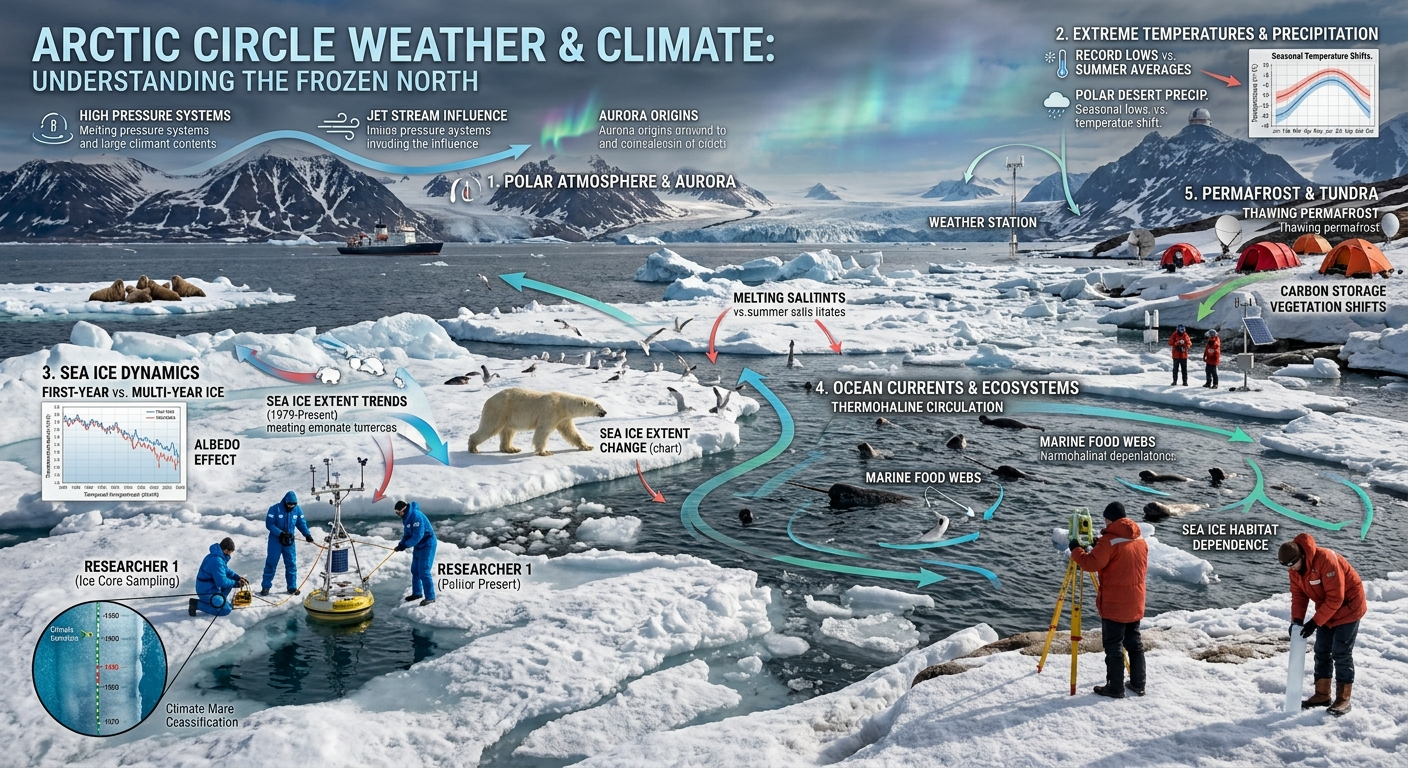
The Arctic is one of the clearest places to observe the effects of a warming planet. Temperatures are rising rapidly compared with the global average, and this is affecting both land and ocean environments.
Melting Sea Ice
Seasonal sea ice has declined significantly over recent decades. The summer minimum has become smaller, while thinner ice is increasingly common in many areas.
This matters because sea ice is more than frozen water. It provides habitat and hunting platforms for animals such as polar bears and seals and influences marine ecosystems and ocean-atmosphere interactions.
Effects on Wildlife and Ecosystems
Changing temperatures can alter migration routes, breeding conditions, food availability, and relationships between predators and prey. Animals adapted to particular ice or snow conditions may find it increasingly difficult to maintain their traditional patterns.
Permafrost is also warming in many areas. When frozen ground thaws, it can damage roads and buildings while releasing carbon that has been stored in frozen soils for long periods.
Why Arctic Changes Matter Globally
Changes in the Arctic do not remain confined to the far north. Melting land ice contributes to global sea-level rise, while changes in snow and ice affect how much solar energy Earth reflects.
Scientists are also studying how Arctic warming may influence atmospheric circulation and weather patterns at lower latitudes. The Arctic is therefore an important part of the Earth’s interconnected climate system.
Northern Lights and Other Natural Wonders
The Northern Lights, or Aurora Borealis, are among the Arctic’s most spectacular natural phenomena. They occur when charged particles from the Sun interact with Earth’s magnetic field and upper atmosphere, producing moving displays of light.
The midnight sun offers another extraordinary experience. Instead of darkness arriving after sunset, the landscape can remain illuminated for hours or even weeks, depending on latitude and season.
Snow-covered mountains, glaciers, frozen lakes, coastal cliffs, and wide tundra landscapes add to the region’s appeal. Together, these features make the Arctic one of the world’s most distinctive natural environments.
Visiting the Arctic Circle
Arctic travel has grown in popularity, with visitors seeking both natural beauty and unique cultural experiences. Popular destinations include northern Norway, Swedish and Finnish Lapland, Iceland, Greenland, northern Canada, and parts of Alaska and Russia.
Travel experiences may include:
- Northern Lights tours
- Dog sledding and winter excursions
- Snowshoeing and cross-country skiing
- Wildlife watching
- Boat trips and whale watching
- Visits to Indigenous cultural sites
- Midnight-sun sightseeing
- Glacier and tundra excursions
Travelers should prepare carefully for Arctic conditions. Weather can change quickly, temperatures can be severe, and daylight varies dramatically by season. Responsible tourism is especially important because Arctic ecosystems can be fragile and slow to recover from disturbance.
Conservation and the Future
Protecting the Arctic ecosystem requires cooperation among scientists, governments, Indigenous communities, conservation organizations, businesses, and travelers.
Wildlife conservation programs help protect vulnerable species and habitats, while scientific research improves understanding of sea ice, ocean temperatures, permafrost, atmospheric conditions, and ecological change.
Sustainable tourism can also contribute positively when visitors respect local communities, follow wildlife guidelines, minimize waste, and choose responsible operators.
The future of the Arctic will depend largely on how the world responds to climate change. Continued scientific research is essential, but so are reductions in greenhouse-gas emissions and thoughtful management of Arctic resources.
Conclusion
The Arctic Circle is far more than a line on a map. It is a dynamic region where ice, ocean, atmosphere, wildlife, and human communities interact in remarkable ways. Its extreme Arctic climate creates unusual natural phenomena such as the midnight sun and polar night while supporting animals specially adapted to life in severe conditions.
At the same time, rapid environmental change is transforming the region. Declining sea ice, warming permafrost, shifting ecosystems, and pressures on Arctic communities demonstrate why the far north matters to the entire planet.
For scientists, the Arctic provides an essential window into Earth’s climate system. For wildlife, it is a critical habitat. For Indigenous communities, it is home. And for travelers, it offers extraordinary landscapes and experiences. Understanding and protecting the Arctic Circle is therefore not only about preserving a remote part of the world—it is about protecting an important part of Earth’s shared future.
✍️ Written by Vimal Bhagat
🌎 Sharing fresh news, trending stories & interesting updates from around the world.
💙 Read more: https://arcticcircle.us
