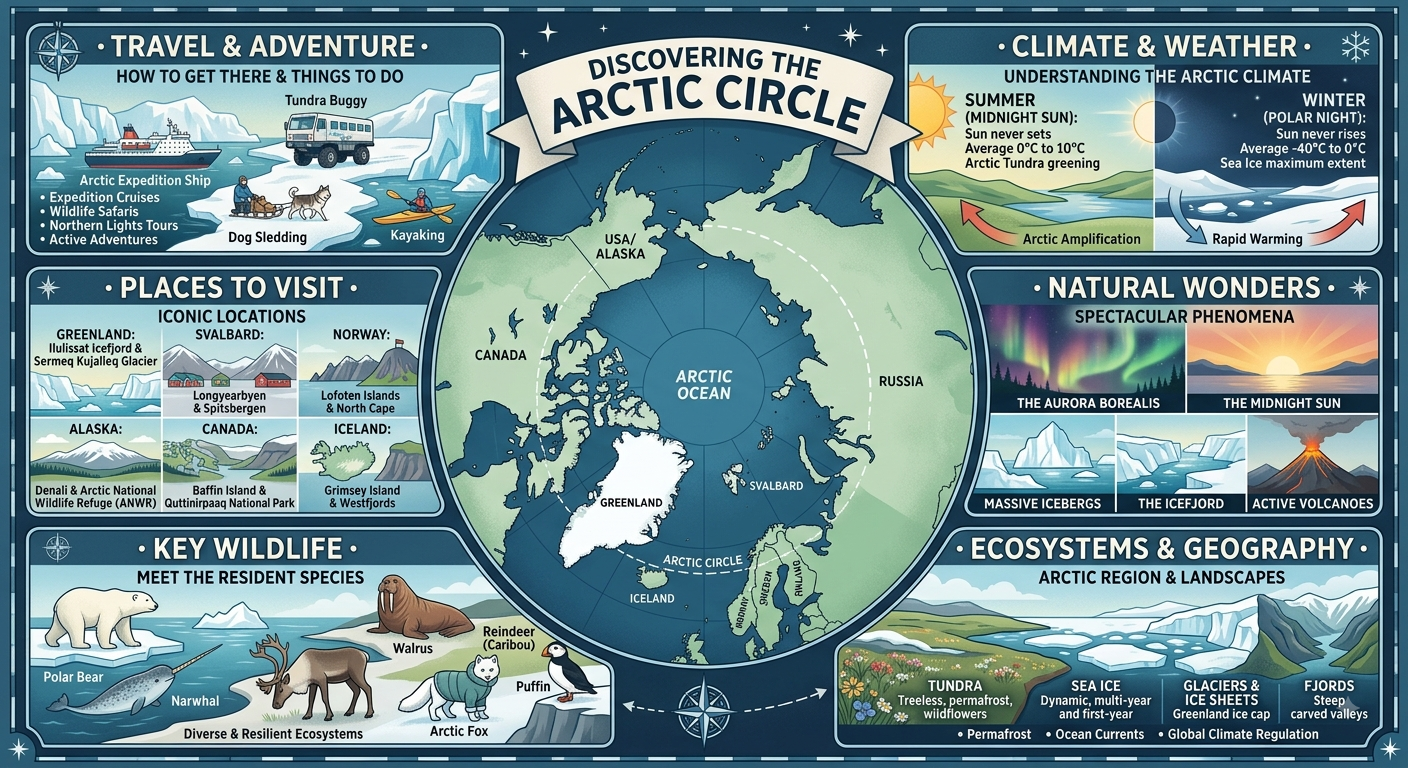
The Arctic Circle is one of the most remarkable geographical regions on Earth. Stretching across the far north of the planet, it is a place of frozen seas, vast tundra, dramatic mountains, and long periods of unusual daylight and darkness. Although the Arctic region can appear remote and inhospitable, it supports an extraordinary variety of wildlife and has been home to human communities for thousands of years.
Beyond its natural beauty, the Arctic Circle has global importance. Changes in its sea ice, temperatures, and ecosystems can influence weather patterns, ocean conditions, wildlife, and climate far beyond the polar region. For travelers, meanwhile, the Arctic offers rare opportunities to experience the Northern Lights, midnight sun, Arctic wildlife, and landscapes unlike almost anywhere else.
Introduction to the Arctic Circle
What Is the Arctic Circle?
The Arctic Circle is an imaginary line of latitude located approximately 66.5 degrees north of the Equator. It marks the southern boundary of an area where, at least once each year, the Sun can remain above the horizon for 24 hours or remain below it for 24 hours.
The Arctic Circle passes through or near several countries, including Norway, Sweden, Finland, Russia, the United States, Canada, Greenland, and Iceland. However, the geographical Arctic is larger than the area immediately surrounding this latitude.
Its position is not completely fixed. Because Earth’s axial tilt changes gradually over long periods, the exact location of the Arctic Circle shifts slightly over time.
Why Is the Arctic Circle Unique?
The most distinctive feature of the Arctic Circle is its relationship with sunlight. During summer, locations north of the circle can experience the midnight sun, when daylight continues through the night. In winter, the same areas can experience polar night, when the Sun does not rise above the horizon for an extended period.
These unusual conditions shape the Arctic climate, wildlife behavior, vegetation, and traditional ways of life.
Geography and Climate
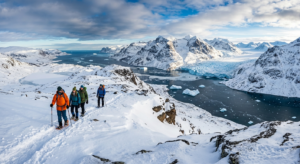
The Arctic landscape is remarkably diverse. It includes frozen oceans, rocky coastlines, glaciers, mountains, wetlands, islands, and enormous stretches of tundra.
Ice, Snow, Tundra and Frozen Seas
The Arctic Ocean is covered by sea ice that expands and contracts according to the seasons. Around it lies tundra, a cold landscape where trees are generally unable to grow because of low temperatures, short growing seasons, and frozen ground.
Permafrost—soil that remains frozen for long periods—is another important feature of the Arctic ecosystem. It stores large amounts of carbon and supports unique vegetation adapted to difficult conditions.
Arctic temperatures vary considerably between locations and seasons. Winters can be extremely cold, while coastal areas influenced by ocean currents may have relatively moderate conditions.
Polar Day and Polar Night
The changing position of the Sun creates some of the Arctic’s most fascinating natural phenomena. North of the Arctic Circle, summer brings increasingly long periods of daylight. Near the North Pole, the Sun can remain above the horizon for months.
Winter produces the opposite effect. Darkness dominates the landscape for long periods, although the sky may still glow with twilight and, under suitable conditions, the Northern Lights.
Wildlife and Ecology
Despite the harsh Arctic climate, the region supports an impressive range of animals. Arctic wildlife has evolved specialized ways to survive freezing temperatures, limited food availability, and dramatic seasonal changes.
Polar Bears and Arctic Foxes
The polar bear is perhaps the best-known Arctic animal. It is highly adapted to life around sea ice, where it hunts seals and travels across frozen environments. Its thick fur and substantial layer of body fat provide protection from the cold.
The Arctic fox has a different survival strategy. Its compact body, dense fur, and seasonal coat changes help it conserve heat. During winter, its white coat can provide camouflage against snow.
Reindeer, Caribou and Marine Animals
Reindeer, known as caribou in North America, are among the Arctic’s important land mammals. They can travel great distances in search of food and have physical adaptations that help them move across snow.
Seals are closely connected to the region’s sea ice, while whales such as bowhead, beluga, narwhal, and several migratory species use Arctic waters during different parts of the year.
The Arctic also attracts millions of migratory birds. Many travel enormous distances between their Arctic breeding grounds and warmer winter habitats.
Surviving Extreme Conditions
Arctic species use several strategies to survive. Some grow thick insulating fur or layers of fat, while others migrate seasonally. Certain animals change their coloring, alter their diets, or reduce their activity during the harshest months.
The timing of these adaptations is closely connected to temperature, daylight, snow, and sea ice. This means that rapid environmental changes can affect entire food chains.
People and Life in the Arctic
The Arctic is not an empty wilderness. It is home to diverse Indigenous peoples and modern communities spread across several countries.
Indigenous Communities and Traditional Lifestyles
Indigenous Arctic communities have developed deep knowledge of local landscapes, weather, animals, ice conditions, and seasonal cycles. Traditional activities have included hunting, fishing, herding, gathering, and travel across difficult terrain.
In many communities, this knowledge continues to play an important role even as modern technologies and economies become increasingly influential.
The relationship between people and the environment is particularly important in the Arctic because changes in sea ice, wildlife populations, and weather can directly affect food, transportation, housing, and cultural practices.
Modern Challenges
Arctic communities face a changing environment as well as economic and social pressures. Melting ice can make some traditional travel routes less predictable, while coastal erosion can threaten settlements.
At the same time, Arctic communities are participating in scientific research, environmental management, tourism, and efforts to protect cultural heritage.
Climate Change in the Arctic
The Arctic is one of the clearest regions for observing the effects of a warming planet. Temperatures are rising, sea ice is changing, and ecosystems are responding to new environmental conditions.
Melting Sea Ice and Rising Temperatures
Sea ice naturally expands during winter and decreases during summer. However, long-term warming has reduced the amount and thickness of Arctic sea ice compared with historical conditions.
This matters because sea ice is not simply frozen water. It provides habitat and hunting platforms for animals, influences ocean circulation, and reflects sunlight back into space.
Why Arctic Changes Matter Globally
The Arctic is closely connected to the rest of Earth’s climate system. Changes in snow and ice can affect how much solar energy is absorbed by the planet. Changes in ocean and atmospheric conditions can also influence weather and climate patterns at lower latitudes.
As a result, protecting the Arctic is not only about preserving a distant polar landscape. It is part of the broader effort to understand and address global climate change.
Northern Lights and Natural Wonders
The Arctic Circle is famous for spectacular natural phenomena.
Aurora Borealis
The Northern Lights, or aurora borealis, appear when charged particles from the Sun interact with Earth’s magnetic field and atmosphere. The result can be ribbons and curtains of green, purple, pink, or other colors moving across the night sky.
Northern locations provide some of the world’s most popular opportunities for viewing the aurora, particularly during the darker months when skies are clear.
Midnight Sun
The midnight sun creates an entirely different experience. During the warmer months, daylight can continue through the night, bathing mountains, forests, coastlines, and tundra in soft light.
For photographers and travelers, this extended daylight provides unusual opportunities to explore landscapes without the normal limitations of nighttime.
Visiting the Arctic Circle
Arctic travel has become increasingly popular among people looking for unusual landscapes and outdoor experiences.
Popular Arctic Destinations
Travelers can explore Arctic environments in places such as northern Norway, Swedish and Finnish Lapland, northern Canada, Alaska, Greenland, Iceland, and parts of northern Russia where tourism is accessible.
Each destination offers a different combination of landscapes, wildlife, cultural experiences, and seasonal activities.
Experiences for Travelers
Depending on the destination and season, visitors may enjoy:
- Wildlife watching and nature photography
- Northern Lights tours
- Dog sledding
- Snowshoeing and cross-country skiing
- Snowmobile excursions where permitted
- Boat trips and whale watching
- Hiking beneath the midnight sun
- Visits to Indigenous cultural centers and local communities
Arctic travel requires preparation. Weather can change quickly, winter conditions can be severe, and some destinations are extremely remote. Travelers should follow local safety advice, dress appropriately, respect wildlife, and choose responsible tour operators.
Conservation and the Future
The future of the Arctic depends on balancing environmental protection, scientific research, local livelihoods, and carefully managed tourism.
Protecting the Arctic Ecosystem
Conservation efforts focus on protecting habitats, monitoring wildlife populations, reducing pollution, and maintaining healthy marine and terrestrial ecosystems.
Scientific research is especially important. Researchers use satellites, field observations, ocean measurements, wildlife tracking, and climate records to understand how the Arctic is changing.
Sustainable Arctic Travel
Tourism can provide economic opportunities for northern communities, but it must be managed carefully. Responsible visitors can help by respecting local cultures, minimizing waste, avoiding disturbance to wildlife, and supporting businesses that follow sustainable practices.
The future Arctic may look significantly different from the Arctic known by previous generations. Yet the region’s story is not only one of environmental change. It is also a story of resilience, scientific discovery, cultural knowledge, and international cooperation.
Conclusion
The Arctic Circle is far more than a line on a map. It is a dynamic polar region where extreme climate, remarkable wildlife, human cultures, and powerful natural forces come together. Its sea ice and ecosystems provide important clues about the changing global climate, while its Northern Lights, midnight sun, and extraordinary landscapes continue to inspire travelers.
Understanding and protecting the Arctic matters to the entire world. Through responsible Arctic travel, scientific research, wildlife conservation, and respect for Indigenous communities, it is possible to appreciate this extraordinary region while helping preserve its fragile environment for the future.
✍️ Written by Vimal Bhagat
🌎 Sharing fresh news, trending stories & interesting updates from around the world.
💙 Read more: https://arcticcircle.us